
Temp Email vs VPN: Which One Do You Actually Need?
A few months ago, a colleague asked me something that sounded simple but actually had a layered answer:
"I want more privacy online. Should I get a VPN or use a temp email?"
My honest response was: "Depends what you're trying to protect."
He looked slightly annoyed, expecting a clear winner. But the truth is, VPNs and temporary email addresses don't compete with each other. They protect different things. Understanding which tool solves which problem is the difference between actually being safer online and just feeling like you are.
Let me break this down properly.
Two Tools. Two Completely Different Threats.
Before comparing them, you need to understand what each one actually does.
A VPN (Virtual Private Network) encrypts your internet traffic and routes it through a server somewhere else. This hides your IP address from websites you visit and prevents your Internet Service Provider from seeing what you're doing online.
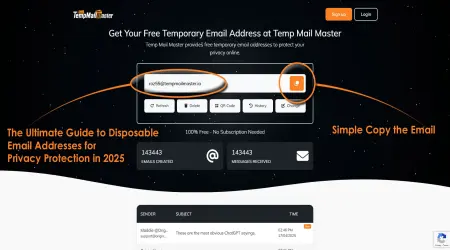
A temporary email address is a disposable inbox — auto-generated, no sign-up required — that you use instead of your real email when websites ask for one. Services like TempMailMaster.io generate one in seconds. You use it, get what you need, and move on.
Same goal (privacy). Completely different mechanisms. Completely different threats addressed.
What a VPN Protects
Think of a VPN as a private tunnel for your internet connection.
When you browse without one, your ISP can see every site you visit. Websites can see your real IP address, which reveals your approximate location and can be used to track you across sessions. On public Wi-Fi, anyone else on the network can potentially intercept your traffic.
A VPN addresses all of that:
- Hides your IP address from websites
- Encrypts your traffic on public Wi-Fi networks
- Prevents your ISP from logging your browsing history
- Lets you appear to be browsing from a different country (useful for geo-restricted content)
What a VPN does NOT address:
- The email address you enter into a sign-up form
- The name, phone number, or other personal data you voluntarily submit
- The spam that lands in your inbox after you hand your email to a marketing website
- Your identity when you create an account with your real email
A VPN hides your network identity. It does nothing about your declared identity — the personal information you actively provide to websites.
What a Temp Email Protects
A temporary email address protects a completely different layer: the information you choose to give websites directly.
Every time you fill in a form with your real email, that address enters a system. It might get added to a marketing automation sequence. Shared with partner companies. Included in data that gets sold to advertisers. Exposed in a breach if the company gets hacked.
None of that is a network problem. It's a data-sharing problem.
A temp email addresses that:
- Your real inbox stays clean — no spam from sites you visited once
- Your email address doesn't end up in third-party marketing databases
- A data breach at a sketchy website exposes a disposable address, not your real one
- You can sign up for things, get what you need, and leave no lasting footprint
What a temp email does NOT address:
- Your IP address (the website still sees your real one unless you're also using a VPN)
- Your browsing activity or ISP visibility
- Security on public Wi-Fi networks
For a deeper look at how your real email becomes a target, this is worth reading: Why Your Real Email Is a Target — and How TempMailMaster.io Shields You
The Honest Comparison Table
| What You're Protecting | VPN | Temp Email |
|---|---|---|
| IP address from websites | ✅ Yes | ❌ No |
| Browsing history from ISP | ✅ Yes | ❌ No |
| Data on public Wi-Fi | ✅ Yes | ❌ No |
| Access to geo-blocked content | ✅ Yes | ❌ No |
| Your inbox from spam | ❌ No | ✅ Yes |
| Identity on sign-up forms | ❌ No | ✅ Yes |
| Email in data breaches | ❌ No | ✅ Yes |
| Data sold to advertisers | ❌ No | ✅ Yes |
| Cost | $3–$10/month | Free |
| Setup required | ✅ Yes (app install) | ❌ No |
| Works instantly | ❌ Needs config | ✅ Yes |
Where People Get Confused
The most common mistake: someone gets a VPN thinking it will stop spam.
It won't. If you use a VPN and then sign up for a newsletter with your real email, that email address is now in their system — regardless of which country your VPN server is in. The VPN protected your connection. It couldn't protect the data you deliberately typed into a form.
The reverse mistake also exists: someone uses a temp email and thinks they're now "private online."
They're not — not fully. Their IP address is still visible. Their ISP can still log their traffic. On public Wi-Fi, their connection may still be vulnerable.
Both tools do exactly one job each. The confusion happens when people expect one job from the wrong tool.
A Real-World Scenario: Coffee Shop + Free Webinar
Let's say you're sitting in a coffee shop, connected to their public Wi-Fi. You want to register for a free webinar you found online.
Without any privacy tools:
- The coffee shop (and anyone on the network) can potentially see your traffic
- The webinar organizer gets your real email and adds it to their list
- Your IP address is logged by their registration system
With only a VPN:
- Your traffic on the coffee shop Wi-Fi is encrypted ✅
- The webinar organizer still gets your real email ❌
- You'll receive marketing emails indefinitely
With only a temp email:
- Your connection on public Wi-Fi is still unprotected ❌
- The webinar organizer gets a disposable address ✅
- Your real inbox stays clean
With both:
- Encrypted connection ✅
- No real email in their system ✅
- You attended the webinar, your digital footprint is minimal
That's the complete picture.
Case Study: Six Months Using Both Together
I started using a temp email as my default for any non-essential sign-up about six months ago. I added a VPN to my regular workflow at the same time.
The results were noticeably different from using either tool alone:
Spam reduction: Dramatic. Roughly 80% less marketing email reaching my real inbox compared to a year earlier.
Peace of mind on public Wi-Fi: Noticeable. I stopped avoiding public networks entirely because I knew the VPN was handling connection security.
One unexpected friction: A few services blocked my temp email domain and required a "real" address. I handled these case by case — if the service was genuinely worth using, I used my real email. If it wasn't, I moved on.
Zero security incidents that I'm aware of across both tools' usage period.
The combination works. But each piece handles its own problem — and neither fixes the other's blind spots.
Which One Should You Start With?
If you had to choose just one right now, here's a practical framework:
Start with a temp email if:
- Your primary frustration is inbox spam
- You frequently sign up for things online and regret it
- You've experienced email-based phishing or targeted marketing
- You want instant, zero-cost protection right now
Start with a VPN if:
- You regularly use public Wi-Fi (airports, cafes, hotels)
- You live in a region with ISP surveillance concerns
- You need to access geo-restricted content
- You're concerned about network-level tracking
Use both if:
- You want comprehensive online privacy
- You're serious about your digital footprint
- You want to protect both your connection and your identity
TempMailMaster.io is free and requires zero setup — you can have a disposable inbox in the next 30 seconds. A good VPN takes a few minutes to install and costs a few dollars a month. There's no reason not to have both in your toolkit.
Common Questions
Does a VPN make temp email unnecessary? No. A VPN doesn't touch your email address or inbox. They operate on completely different layers of your online activity.
Can I use a temp email with a VPN simultaneously? Yes, and you should if you want comprehensive coverage. Use the VPN for your connection; use the temp email for any form that asks for your address.
Are free VPNs worth using? Some are acceptable for basic use, but many free VPN services log your data and sell it to advertisers — which defeats the privacy purpose entirely. Research carefully before trusting a free VPN with your traffic.
Does a temp email work for email-based 2FA? Generally no — two-factor authentication codes are time-sensitive, and many 2FA systems require a permanent email for account recovery. For accounts where security matters, use your real email. For a complete guide to 2FA: see our article on two-factor authentication security.
What about email tracking pixels — does a VPN stop those? No. Tracking pixels operate inside emails that are already in your inbox. A VPN can't prevent tracking once you've opened an email. Temp emails reduce the chance of tracking emails reaching you at all. For more detail: The Invisible Tracker: How to Detect and Defeat Email Tracking Pixels
Is there a single tool that does everything? Not really. Privacy is layered — different tools handle different threats. Temp email, VPN, password manager, 2FA, and a good antivirus together form a reasonable baseline. Each piece covers what the others can't.
References
- EFF — Surveillance Self-Defense Guide https://ssd.eff.org
- Cloudflare — What is a VPN? https://www.cloudflare.com/learning/access-management/what-is-a-vpn/
- ENISA — Cybersecurity Best Practices https://www.enisa.europa.eu
- NIST — Privacy Framework https://www.nist.gov/privacy-framework
- Mozilla — VPN Research and Recommendations https://foundation.mozilla.org/en/privacynotincluded/
- Pew Research — Americans and Online Privacy https://www.pewresearch.org/internet/
- FTC — Protecting Consumer Privacy https://www.ftc.gov/business-guidance/privacy-security
- GDPR.eu — Data Subject Rights https://gdpr.eu/rights/
- Verizon DBIR — Data Breach Investigation Report 2024 https://www.verizon.com/business/resources/reports/dbir/
- Proton — Email privacy and security guide https://proton.me/blog/email-privacy
Published: June 2026 | Author: Arslan | Category: Privacy Tools & Comparisons