
Why Does My Email Keep Getting Sold? (And the One Habit That Stops It)
You unsubscribed. You clicked "remove me from this list." You even marked it as spam. And three days later, a different company — one you've never heard of — is emailing you about something suspiciously similar to what the last company was selling.
You didn't sign up for this. You don't recognize the sender. And yet they have your name, your email, and somehow know you're interested in exactly the right product category.
This isn't a coincidence. And it's not a glitch. It's a system — and once you understand how it works, you'll understand why unsubscribing alone never fixes it.
The Email Economy Nobody Told You About
Your email address has a price tag.
Not a big one per record — usually fractions of a cent in bulk. But at scale, email lists are extraordinarily valuable commercial assets. A list of 100,000 verified, active email addresses belonging to people interested in home improvement products can sell for thousands of dollars.
Who builds these lists? Data brokers. Companies whose entire business model is collecting, enriching, packaging, and selling personal information — including your email address — to anyone willing to pay.
The data broker industry in North America alone is worth over $40 billion. There are hundreds of registered brokers in California alone. Globally, the number of companies trading in personal data runs into the thousands.
Your email is one small piece of a much larger machine.
How Your Email Gets Into the System in the First Place
This is the part most people never connect to their spam problem.
You didn't sign up for a spam list. You signed up for a recipe website. Or downloaded a free template. Or entered a giveaway. Or created an account on a forum you visited twice.
Here's what those websites often do with your email:
1. They Share With "Marketing Partners"
Buried in most privacy policies — the ones nobody reads — is a clause about sharing your data with "trusted partners," "affiliated companies," or "third-party service providers." In practice, this often means your email gets passed to advertising networks, lead generation companies, or directly to data brokers.
This is legal in most jurisdictions. You technically consented when you clicked "I agree."
2. They Get Acquired or Go Bankrupt
When a company gets bought or goes out of business, its assets — including its email list — often get sold. The new owner may have very different data practices than the company you originally trusted. Your email travels with the sale.
3. They Get Breached
Data breaches expose email addresses to criminal markets. Once your email is in a breach database, it gets sold and re-sold indefinitely. A breach from 2019 is still generating spam in 2026.
4. They Directly Monetize Their List
Some websites exist primarily to collect emails. The "free download" or "free trial" is secondary. The real product is the email list they're building — which they sell to brokers the moment it reaches a critical size.
Why Unsubscribing Doesn't Fix It
Here's the painful part: unsubscribing removes you from one sender's list. It does nothing about the dozens of other companies that have already purchased your email from that sender or from a broker who acquired it downstream.
The unsubscribe loop works like this:
- You sign up for a website → they add you to their list
- They sell or share your email → three brokers now have it
- Those brokers sell it → fifteen companies now have it
- One of those companies emails you → you unsubscribe
- That one company removes you → fourteen others still have your email
- Another company emails you → you unsubscribe again
- Repeat indefinitely
You're bailing water with a teaspoon while the faucet stays fully open.
This is why people who've been "cleaning" their inbox for years still get spam. The unsubscribes only address the symptom at the point of contact. They don't reach the source.
The Data Enrichment Problem Makes It Worse
When a broker gets your email address, they don't just store the address. They enrich it.
Enrichment means cross-referencing your email against other databases to build a profile: your name, approximate age, income bracket, interests, location, browsing behavior, purchase history, and more. Your email becomes the thread that ties together dozens of data points about you.
A richer profile is worth more to buyers. So brokers continuously update and expand what they know about each email address in their database.
This is why the spam you receive often feels eerily targeted. The company emailing you may know more about your interests than you consciously shared — because they bought an enriched profile, not just an address.
The One Habit That Actually Stops It
Everything above is the bad news. Here's the good news: the solution is simple, and it works upstream of everything else.
Stop giving your real email to websites that don't genuinely need it.
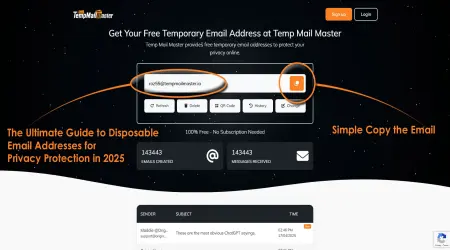
This sounds obvious, but the execution is where most people stumble. The habit that makes it automatic is using TempMailMaster.io as your default email for any sign-up where you don't have a long-term relationship with the service.
Here's why this works when nothing else does:
If the website never gets your real email, they can't sell it. A broker can't buy what was never collected. An enrichment company can't build a profile around an address that expired before they found it.
The disposable inbox absorbs the sign-up confirmation. You get whatever you came for. The temp address expires. And your real email stays entirely outside the system.
No unsubscribing needed. No spam to filter. No breach exposure. The problem simply doesn't start.
What Your Real Email Should Be Reserved For
Using temp email effectively means being deliberate about when your real email is appropriate:
Real email — appropriate:
- Banking and financial services
- Healthcare providers and insurance
- Government services and official registrations
- Work and professional communications
- Accounts you actively use daily (primary email client, cloud storage, etc.)
- People you know personally
Temp email — appropriate:
- Free trial sign-ups
- Content downloads (eBooks, templates, reports)
- Webinar and event registrations
- Coupon and discount code claims
- Forums and communities you're visiting for a single purpose
- Any website you've never visited before
- Any website whose privacy practices you haven't verified
For a detailed breakdown of which sites fall into the temp email category: 5 Smart Ways to Use a Temporary Email and Keep Your Data Safe
A Case Study: Tracing One Email Through the System
I ran an experiment last year. I created a brand-new email address, used it exclusively to sign up for one free resource download from a mid-sized marketing website, and then monitored what happened.
Week 1: One welcome email from the company. One follow-up from their automation sequence.
Week 3: A second company emailed me with a "similar resource" promotion. I had never visited their website. They addressed me by the name I'd used on the original sign-up form.
Week 6: Four different companies had emailed that address. Two referenced products directly related to the topic of the original download. None were companies I had any direct relationship with.
Month 3: Twelve companies had emailed the address. Several had clearly purchased from different brokers — the targeting categories were different, suggesting the profile had been enriched and resold multiple times.
Month 6: The address was receiving daily spam. The original company's domain was nowhere in the sender list — they had apparently sold the list and moved on.
One sign-up. Six months. Twelve companies. Zero of them had a direct relationship with me.
If I had used a TempMailMaster.io address for that original download, the experiment would have ended at week one.
How to Start the Habit Today
You don't need to overhaul your entire digital life. You just need one new reflex.
The next time a website asks for your email:
Step 1: Ask yourself: do I genuinely intend to have an ongoing relationship with this service?
Step 2: If yes — use your real email.
Step 3: If no, or if you're not sure — open TempMailMaster.io, copy the generated address, and use that instead.
Step 4: Complete whatever you came to the website to do. Return to TempMailMaster.io briefly if you need to click a verification link.
Step 5: Close the tab. Move on.
That's it. The habit takes about 30 extra seconds per sign-up. The payoff is an inbox that stops growing.
What About Email Addresses Already in the System?
If your real email has been circulating for years, the practical reality is that you can't fully remove it from existing databases. Brokers re-list data even after opt-out requests are honored. Breach databases don't get scrubbed.
What you can do:
Check your exposure: haveibeenpwned.com shows which breaches have exposed your address.
Submit opt-out requests to major data brokers: Spokeo, BeenVerified, WhitePages, Radaris, and TruePeopleSearch all have opt-out processes. California residents can use the DROP portal to submit a single request to all registered brokers.
Change passwords on any account where a breached password was reused.
Use your real email more selectively going forward — preventing new exposure even if past exposure can't be fully reversed.
The combination of reducing future exposure and cleaning up past exposure is more effective than either approach alone.
FAQ
Is it illegal for companies to sell my email without permission? In many cases, technically no — if you accepted their terms of service, which usually include data sharing provisions. However, GDPR (EU), CCPA (California), and a growing number of state laws are tightening consent requirements. The legal landscape is changing, but enforcement is slow. Prevention is more reliable than regulation.
Why does my spam increase after I unsubscribe from some lists? Clicking an unsubscribe link confirms your email address is active and monitored. Some less scrupulous senders treat this as a signal to send more, or to sell your "confirmed active" address at a premium. Only unsubscribe from senders you recognize and trust.
How do I know if a website is selling my email? You often can't know in advance — the data sharing practices are usually buried in privacy policies. The safest assumption for any website you don't fully trust: they may share your data. Use a temp email and remove the uncertainty.
Do big companies like Google and Amazon sell email data? Major platforms typically don't directly sell your email address — their business model is using your data internally for their own advertising networks. However, when you sign up for third-party services using "Sign in with Google," those third parties may have their own data sharing practices.
Will temp email stop all spam? It prevents spam from originating at sign-ups where you use a disposable address. It doesn't affect spam arriving at your real email from sources that already have it. Combined with the cleanup steps above, it significantly reduces overall volume over time.
References
- Privacy Bee — Data broker industry overview https://privacybee.com/online-privacy-in-2026-guide/
- Have I Been Pwned — Breach checker https://haveibeenpwned.com
- California DELETE Act — DROP portal https://cppa.ca.gov
- FTC — CAN-SPAM Act https://www.ftc.gov/business-guidance/resources/can-spam-act-compliance-guide-business
- GDPR.eu — Consent and data minimization https://gdpr.eu/article-5-how-to-process-personal-data/
- Verizon DBIR 2025 — Breach data https://www.verizon.com/business/resources/reports/dbir/
- EFF — Email privacy guide https://ssd.eff.org
- Pew Research — Online privacy attitudes https://www.pewresearch.org/internet/
- ENISA — Personal data protection https://www.enisa.europa.eu
- IBM — Cost of a Data Breach 2025 https://www.ibm.com/security/data-breach
Published: June 2026 | Author: Arslan | Category: Email Privacy & Spam Prevention