
Anonymous Crypto Sign Up: Best Temp Mail Strategy
Secure Cryptocurrency Registration: A Complete Guide to Protecting Your Privacy with Temporary Email Services
In today's digital financial landscape, protecting your personal information during cryptocurrency registration has become essential. While blockchain technology promises decentralization and privacy, the onboarding process for most exchanges creates an immediate privacy vulnerability through email registration requirements. This comprehensive guide reveals professional strategies for maintaining anonymity during crypto sign-ups using temporary email solutions.
Understanding Privacy Risks in Cryptocurrency Registration
Traditional cryptocurrency exchange registration links your personal email address directly to your trading activities, creating multiple security vulnerabilities that extend far beyond simple spam concerns.
The Real Costs of Using Personal Email for Crypto Accounts
When you register for a cryptocurrency platform using your primary email address, you're creating a permanent digital trail that connects your real-world identity to your financial activities. This connection exposes you to several serious risks:
Sophisticated Phishing Campaigns: Cybercriminals specifically target individuals with known cryptocurrency holdings. Once your email appears in exchange databases, you become a prime candidate for advanced social engineering attacks designed to steal login credentials, private keys, or directly manipulate you into transferring funds.
Data Breach Consequences: Centralized exchanges represent high-value targets for malicious actors. Historical breaches have exposed millions of user records, including email addresses, transaction histories, and associated personal data. This information frequently appears on underground marketplaces, making you vulnerable to identity theft and targeted attacks.
Regulatory Tracking: Government agencies worldwide are implementing increasingly sophisticated cryptocurrency tracking systems. Your registered email creates an easily traceable connection between your real identity and blockchain transactions, potentially compromising financial privacy that many cryptocurrency users seek.
Perpetual Marketing Exposure: Beyond security concerns, using your primary email guarantees continuous promotional communications from exchanges, affiliated services, and third-party partners who acquire user lists through various channels.
Why Privacy-Conscious Traders Choose Anonymous Registration
Professional cryptocurrency traders and privacy advocates understand that true financial sovereignty begins with protecting your identity at every entry point. By establishing anonymous accounts, you create critical separation between your public identity and your financial activities, reducing attack surfaces and maintaining the privacy advantages that cryptocurrency technology theoretically provides.
Essential Tools for Anonymous Cryptocurrency Registration
Achieving genuine anonymity during crypto exchange registration requires combining multiple privacy-enhancing technologies. Each component serves a specific protective function, and together they create comprehensive identity shielding.
Virtual Private Networks: Your First Line of Defense
A Virtual Private Network (VPN) forms the foundation of anonymous browsing by encrypting your internet connection and masking your actual IP address. When selecting a VPN for cryptocurrency-related activities, prioritize services that:
- Maintain a verified no-logs policy
- Offer servers in multiple jurisdictions
- Support strong encryption standards (AES-256 minimum)
- Allow cryptocurrency payment options
- Provide kill-switch functionality to prevent IP leaks
Choose VPN server locations in countries with strong privacy laws and limited surveillance agreements. Jurisdictions like Switzerland, Iceland, and certain Caribbean nations offer advantageous privacy frameworks.
Temporary Email Services: Disposable Identity Shields
Temporary email services provide anonymous, disposable email addresses that require no personal information for creation. Unlike traditional email providers that demand phone numbers, recovery emails, and identity verification, quality temporary email platforms generate instant addresses without any registration process.
Key Features of Professional Temporary Email Services:
- Zero personal information requirements
- Instant address generation
- Secure inbox protection against unauthorized access
- Sufficient lifespan for account verification processes
- No permanent storage of communications
- Protection against cross-user data exposure
Services like TempMailMaster.io exemplify professional temporary email platforms by offering secure, private inboxes without requiring any user registration or personal data collection.
Privacy-Focused Browsers: Eliminating Digital Fingerprints
Your browser choice significantly impacts anonymity. Standard browsers like Chrome actively track browsing behavior and maintain extensive user profiles. For maximum privacy during anonymous registration:
Recommended Browser Options:
- Brave Browser: Built-in tracking protection and cryptocurrency integration
- Firefox: Enhanced privacy settings with tracking protection
- Tor Browser: Maximum anonymity through onion routing (may trigger exchange security flags)
Always operate in private browsing mode (Incognito/Private Window) to prevent cookie tracking, cache storage, and browsing history retention. This ensures each session starts clean without residual identifying data.
Step-by-Step Anonymous Crypto Exchange Registration
Follow this systematic approach to create a cryptocurrency exchange account while maintaining complete anonymity. Each step builds upon the previous one to establish comprehensive privacy protection.
Phase 1: Establishing Your Anonymous Connection
Step 1: Activate VPN Protection
Before opening any browser or navigating to any websites, establish your VPN connection. This crucial first step ensures all subsequent traffic routes through encrypted tunnels, hiding your actual location and IP address from the start.
Select a VPN server strategically:
- Choose privacy-friendly jurisdictions
- Consider exchange location restrictions
- Verify server load for optimal performance
- Confirm connection stability before proceeding
Step 2: Configure Privacy-Enhanced Browser
Launch your privacy-focused browser in private mode. This configuration prevents tracking through several mechanisms:
- Blocks third-party cookies automatically
- Disables browser fingerprinting techniques
- Prevents session data retention
- Isolates browsing from regular activities
Verify your VPN connection is active by checking your apparent IP address through a privacy-checking service. Confirm the displayed location matches your VPN server selection.
Phase 2: Creating Your Disposable Identity
Step 3: Generate Anonymous Email Address
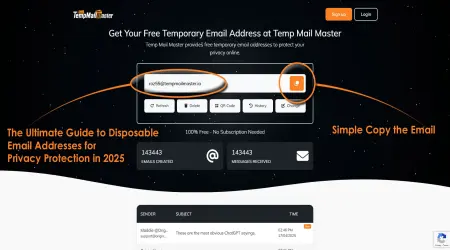
Navigate directly to TempMailMaster.io in your privacy-configured browser. The service immediately generates a random, anonymous email address without requiring any form creation or personal data input.
Keep this browser tab active throughout the registration process. You'll need access to this inbox to receive and interact with verification emails from the exchange.
Critical Advantages of Quality Temporary Email Services:
Professional temporary email platforms offer security features that prevent common vulnerabilities found in basic disposable email services:
- Individual secure inboxes prevent other users from accessing your messages
- No shared address pools that create privacy risks
- Sufficient session duration for completing lengthy verification processes
- Protection against timing attacks and session hijacking
Step 4: Select Appropriate Crypto Exchange
Choose exchanges that align with your anonymity goals. Not all platforms support anonymous registration, so understanding exchange categories is essential:
No-KYC Exchanges: Allow trading up to specified limits without identity verification KYC-Optional Exchanges: Offer basic functionality without verification, with enhanced features requiring identification Strict-KYC Exchanges: Require immediate identity verification (incompatible with anonymous registration)
Research each exchange's policies carefully, as requirements change frequently based on regulatory developments. Focus on platforms with established no-KYC tiers that meet your trading needs.
Phase 3: Completing Anonymous Registration
Step 5: Execute Registration Form
Navigate to your selected exchange's registration page while maintaining your VPN connection and private browsing session. Complete the registration form with these security considerations:
Email Address: Copy your temporary email address from TempMailMaster.io and paste it into the registration field. Avoid manually typing the address to prevent transcription errors.
Password Creation: Generate a strong, unique password using a password manager. Critical password requirements:
- Minimum 16 characters combining uppercase, lowercase, numbers, and symbols
- Never reuse passwords from other accounts
- Store securely in encrypted password manager
- Consider using passphrase methodology for memorable yet complex passwords
Username Selection: If required, choose a username completely unrelated to any other online identities. Avoid patterns, preferences, or references that could link back to you.
Step 6: Complete Email Verification
Exchanges send verification emails to confirm account ownership. Switch to your TempMailMaster.io browser tab and wait for the verification message to arrive. Most exchanges deliver these emails within 1-3 minutes.
When the verification email appears:
- Review the sender address carefully for authenticity
- Click verification links within the same private browsing session
- Copy verification codes if required and paste them into the exchange platform
- Ensure the verification process completes successfully before closing any tabs
Important Session Continuity: Verification links should open in new tabs within your current private browsing session, not in separate browser windows. This maintains consistent IP address presentation and prevents verification failures.
Phase 4: Securing Your Anonymous Account
Step 7: Implement Two-Factor Authentication
Immediately after successful email verification, enable Two-Factor Authentication (2FA). This critical security measure protects your account even if someone obtains your password.
2FA Implementation Best Practices:
Use authenticator apps rather than SMS-based verification:
- Google Authenticator
- Authy
- Microsoft Authenticator
- 1Password (with built-in authenticator)
Critical SMS-Based 2FA Warning: Avoid SMS-based two-factor authentication, as it links your phone number to the account, undermining your anonymity efforts and exposing you to SIM-swapping attacks.
Backup Code Management: When enabling 2FA, exchanges provide backup codes for emergency access. Store these codes securely:
- Save in encrypted password manager
- Write on paper stored in secure physical location
- Never store in cloud services or unencrypted files
- Treat backup codes as sensitive as passwords themselves
Advanced Operational Security for Ongoing Anonymity
Creating an anonymous account represents only the beginning of maintaining privacy. Long-term operational security requires consistent practices that preserve your anonymity throughout your trading activities.
Maintaining Consistent Connection Patterns
Exclusive VPN Usage: Never access your anonymous exchange account without an active VPN connection. Each login without VPN protection exposes your real IP address, creating traceable patterns that could compromise your identity.
Develop these habits:
- Verify VPN connection before opening browser
- Use consistent server locations to avoid triggering security flags
- Monitor for connection drops that could expose your real IP
- Consider enabling VPN automatic connection on system startup
Dedicated Browser Practices: Consider using a separate browser profile or entirely different browser exclusively for accessing your anonymous exchange accounts. This isolation prevents accidental cross-contamination between your public and private identities through:
- Separate bookmark collections
- Isolated cookie storage
- Distinct browsing histories
- Independent extension sets
Preventing Identity Linkage
Avoiding Personal Information Addition: Resist all prompts to add personal information to your account:
- Real name or legal names
- Phone numbers or SMS capabilities
- Personal bank accounts or credit cards
- Social media profile links
- Profile photos or identifying images
Many exchanges encourage completing profiles for "enhanced security" or "faster support." These features invariably compromise anonymity by creating additional identity linkage points.
Communication Security: If you must contact exchange support:
- Use only the temporary email associated with the account
- Provide no identifying information in messages
- Avoid mentioning location, timezone, or personal circumstances
- Keep communications strictly technical and impersonal
Understanding On-Chain Privacy Limitations
While your exchange account may be anonymous, blockchain transactions themselves are permanently public. Understanding this limitation is crucial for maintaining comprehensive privacy.
Transaction Privacy Considerations:
When depositing cryptocurrency to your anonymous exchange account, the blockchain transaction linking your wallet to the exchange deposit address is publicly visible and permanently recorded. Similarly, withdrawals create public connections between the exchange and your destination wallet.
Privacy-Enhancement Techniques:
For users requiring maximum transaction privacy:
- Cryptocurrency Mixers: Services that obscure transaction trails by pooling funds from multiple users
- Privacy Coins: Cryptocurrencies like Monero or Zcash with built-in privacy features
- CoinJoin Transactions: Bitcoin-specific privacy technique combining multiple transactions
- Layered Transfers: Moving funds through multiple wallets to obscure direct connections
Important Legal Consideration: Transaction privacy techniques may face regulatory scrutiny in certain jurisdictions. Research local regulations before implementing advanced privacy measures.
Selecting No-KYC Cryptocurrency Exchanges
Not all exchanges support anonymous registration. Understanding the landscape of no-KYC platforms helps you identify suitable options for private trading.
Categories of Exchange Verification Requirements
Tier 1 - No-KYC Exchanges: These platforms allow full trading functionality up to specified daily or monthly limits without requiring identity verification. Limits typically range from $1,000 to $10,000 daily.
Tier 2 - KYC-Optional Exchanges: Offer basic trading without verification but require identity documents for:
- Higher transaction limits
- Fiat currency deposits/withdrawals
- Advanced trading features
- Margin trading or derivatives
Tier 3 - Mandatory KYC Exchanges: Require immediate identity verification before any trading functionality becomes available. These platforms are incompatible with anonymous registration strategies.
Evaluating Exchange Security and Reliability
When selecting no-KYC exchanges, security and reliability become paramount since you cannot rely on identity-based account recovery:
Critical Evaluation Factors:
- Exchange History: Operating duration, ownership transparency, regulatory standing
- Security Practices: Cold storage percentages, security audit results, insurance coverage
- User Reviews: Community feedback, complaint resolution, support responsiveness
- Trading Volume: Sufficient liquidity for your trading needs
- Cryptocurrency Selection: Supported coins and trading pairs
- Fee Structure: Trading fees, withdrawal fees, hidden charges
Red Flags to Avoid:
- New exchanges without established track records
- Platforms with frequent security incidents
- Services with poor customer support reputation
- Exchanges facing regulatory investigations
- Platforms with suspicious ownership structures
Geographic Restrictions and VPN Detection
Many exchanges implement geographic restrictions based on regulatory requirements. Your VPN server location may affect account creation and functionality:
Common Restricted Jurisdictions:
- United States (varies by state)
- European Union members (GDPR compliance)
- China and other restrictive nations
- Sanctioned countries
Some exchanges employ VPN detection mechanisms that may block registration attempts from known VPN IP ranges. If you encounter access issues:
- Try different VPN server locations
- Use residential IP VPN services
- Consider exchanges specifically designed for privacy-focused users
Temporary Email Services: Technical Implementation
Understanding how temporary email services function helps you select appropriate providers and use them effectively for cryptocurrency registration.
How Professional Temporary Email Platforms Operate
Quality temporary email services generate random email addresses instantly using their own domain infrastructure. When you access TempMailMaster.io, the service:
- Creates a unique, random address using their domain
- Establishes a temporary inbox associated with that address
- Receives all emails sent to that address
- Makes messages available through your browser session
- Automatically deletes the inbox after a specified duration
Session Duration Considerations: Different temporary email services offer varying inbox lifespans. For cryptocurrency exchange registration, ensure your chosen service maintains the inbox long enough to:
- Complete initial registration verification
- Receive any follow-up security confirmations
- Access the account for 2FA setup
- Handle any initial login verification requirements
Security Features of Quality Temporary Email Services
Not all temporary email services provide equal security. Premium platforms like TempMailMaster.io implement crucial protections:
Individual Secure Inboxes: Each generated address connects to a private inbox accessible only through your specific browser session. This prevents other users from viewing your messages.
Session Authentication: Secure temporary email services use session-based authentication to verify inbox access rights, preventing unauthorized users from guessing or accessing your temporary address.
No Data Persistence: Professional services permanently delete inbox contents after session expiration, ensuring no residual data remains that could be compromised or accessed later.
Protection Against Common Vulnerabilities:
- Cross-user access prevention
- Timing attack mitigation
- Injection attack resistance
- Session hijacking protection
Temporary Email Address Lifespan Management
Most exchanges complete registration verification within minutes, but some may take longer. Understanding inbox lifespan helps you plan registration timing:
Typical Session Durations:
- Standard temporary email: 10-60 minutes
- Extended services: Several hours to days
- Premium options: Custom duration control
For cryptocurrency registration, select services offering at least 60 minutes of inbox access to accommodate potential delays in verification email delivery or complications during registration.
Password Security and Account Recovery Challenges
Anonymous accounts present unique challenges for password management and account recovery. Understanding these limitations helps you prepare appropriate safeguards.
Creating and Managing Strong Passwords
Your password represents the primary defense for anonymous accounts since traditional identity-based recovery methods are unavailable:
Password Strength Requirements:
- Minimum 16 characters (20+ recommended)
- Combination of uppercase and lowercase letters
- Multiple numbers and special characters
- No dictionary words or common phrases
- No personal information or patterns
Password Manager Integration: Use dedicated password management software to:
- Generate cryptographically random passwords
- Store passwords securely with encryption
- Sync passwords across devices (with encrypted cloud storage)
- Organize exchange credentials separately from personal accounts
Recommended Password Managers:
- 1Password: User-friendly interface with strong security
- Bitwarden: Open-source with self-hosting options
- KeePass: Fully offline password database
- LastPass: Comprehensive free tier with premium options
Account Recovery Limitations
Anonymous accounts cannot use standard recovery methods like identity verification or answering security questions. This creates both advantages and challenges:
Recovery Method Unavailability:
- Cannot verify identity through government documents
- Cannot use recovery email addresses linked to real identity
- Cannot receive SMS verification codes without compromising anonymity
- Cannot rely on customer support with identity verification
Alternative Recovery Strategies:
- 2FA Backup Codes: Treat these as absolutely critical. Store multiple copies in secure locations
- Password Manager Backups: Maintain encrypted backups of your password database
- Secure Documentation: Keep encrypted records of account details in secure storage
- Multiple Access Methods: Configure 2FA with multiple devices when possible
Recovery Failure Implications: If you lose access to your anonymous account without backup codes or password manager access, the account and its contents become permanently inaccessible. No customer support process can recover accounts without identity verification.
Cryptocurrency Deposit and Withdrawal Privacy
Transaction privacy extends beyond account creation. Understanding blockchain visibility helps you protect privacy during deposits and withdrawals.
Blockchain Transaction Transparency
Every cryptocurrency transaction creates a permanent, public record on the blockchain. When you deposit funds to an exchange:
- Your sending wallet address becomes publicly linked to the exchange deposit address
- Transaction amounts, timestamps, and fees are permanently visible
- Anyone can analyze transaction patterns using blockchain explorers
- Multiple deposits create pattern data that sophisticated analysts can interpret
Transaction Graph Analysis: Professional blockchain analytics companies track fund movements across the network, identifying patterns that can link wallets to specific individuals or organizations.
Deposit Privacy Enhancement Strategies
New Wallet Creation: Never deposit directly from wallets previously linked to your identity. Instead:
- Create fresh wallets specifically for exchange deposits
- Transfer funds through multiple intermediate wallets
- Vary transfer amounts and timing to obscure patterns
- Avoid round numbers that suggest manual transfers
Privacy-Focused Cryptocurrencies: Consider using cryptocurrencies with built-in privacy features:
Monero (XMR): Implements ring signatures and stealth addresses for transaction privacy Zcash (ZEC): Offers shielded transactions that hide sender, receiver, and amount Dash (DASH): Provides PrivateSend mixing service for enhanced privacy
These cryptocurrencies make transaction analysis significantly more difficult, though not all exchanges support them.
Withdrawal Privacy Considerations
When withdrawing funds from your anonymous exchange account:
Destination Wallet Selection: Create new wallets specifically for receiving exchange withdrawals. Never withdraw directly to wallets that:
- Contain personally-identified funds
- Have been used for KYC-verified exchanges
- Are linked to identifiable merchants or services
- Have public association with your identity
Transaction Mixing Services: For Bitcoin and similar cryptocurrencies, consider using mixing services that obscure transaction trails:
CoinJoin Implementations:
- Wasabi Wallet: Bitcoin privacy wallet with built-in CoinJoin
- Samourai Wallet: Mobile Bitcoin wallet with Whirlpool mixing
- JoinMarket: Decentralized CoinJoin implementation
Important Legal Warning: Some jurisdictions view mixing services with suspicion or explicitly prohibit their use. Research local regulations before implementing transaction mixing.
Common Mistakes That Compromise Anonymity
Even careful users sometimes make errors that undermine anonymous accounts. Understanding common mistakes helps you avoid them.
Identity Leakage Through Behavioral Patterns
Timing Patterns: Accessing your anonymous account during consistent hours or immediately after accessing identifiable accounts can create timing correlations that sophisticated adversaries might detect.
Mitigation Strategies:
- Vary access times randomly
- Use different VPN server locations for different accounts
- Avoid accessing anonymous and personal accounts in rapid succession
- Consider using separate devices for maximum isolation
Browser Fingerprinting: Even with privacy browsers, unique combinations of settings, fonts, and configurations can create identifying fingerprints:
Protection Measures:
- Use common browser configurations without extensive customization
- Disable or minimize browser extensions for anonymous sessions
- Regularly clear browser data between sessions
- Consider using browser isolation tools like separate profiles or virtual machines
Accidental Personal Information Disclosure
Profile Completion Temptations: Exchanges often offer incentives for completing profiles or verification steps. Resist these regardless of offered benefits:
- Trading fee discounts conditional on verification
- Higher withdrawal limits with identity documents
- VIP programs requiring personal information
- Competition or promotional entries demanding details
Any personal information addition compromises your anonymity permanently and cannot be truly removed.
Support Communication Errors: When contacting exchange support, users sometimes accidentally reveal identifying information:
- Mentioning location, timezone, or regional references
- Using personal email addresses for correspondence
- Including names or phone numbers in support tickets
- Referencing other accounts or services that contain identifying information
Maintain strict discipline in all communications, providing only technical details about specific issues.
VPN Consistency Failures
Connection Drop Exposure: VPN connections sometimes drop unexpectedly, briefly exposing your real IP address. This creates a trackable connection between your real location and the anonymous account:
Prevention Measures:
- Enable VPN kill switch functionality
- Monitor connection status continuously
- Configure network to block non-VPN traffic
- Test connection stability before using anonymous accounts
Server Location Changes: Frequently changing VPN server locations may trigger exchange security systems:
Best Practices:
- Use consistent VPN server locations for each account
- Document which servers you've used for each account
- Understand that server location changes may trigger additional verification requests
- Consider dedicated IP addresses for high-value accounts
Legal and Regulatory Considerations
Anonymous cryptocurrency registration exists in a complex legal landscape that varies significantly across jurisdictions.
Understanding Regional Regulations
Cryptocurrency Regulation Variation: Different countries and regions impose varying requirements on cryptocurrency exchanges and users:
Strict Regulatory Environments:
- United States: FinCEN regulations, state-level restrictions
- European Union: MiCA regulations, GDPR compliance
- China: Comprehensive cryptocurrency restrictions
- Singapore: Strict licensing requirements for exchanges
Privacy-Friendly Jurisdictions:
- Switzerland: Supportive cryptocurrency regulations
- Portugal: Favorable tax treatment
- Malta: "Blockchain Island" initiatives
- Estonia: E-residency and digital-friendly policies
Regulatory Compliance Responsibility: Users bear responsibility for understanding and complying with regulations in their jurisdiction. Exchange terms of service typically prohibit users from restricted countries.
Anti-Money Laundering (AML) Considerations
Global AML Standards: Financial Action Task Force (FATF) recommendations increasingly affect cryptocurrency regulations worldwide:
"Travel Rule" Implementation: Many jurisdictions now require exchanges to collect and share customer information for transactions above certain thresholds, typically $1,000-$3,000 USD equivalent.
Impact on Anonymous Trading: As AML regulations tighten, no-KYC exchanges face increasing pressure to implement identity verification or cease operations. This trend suggests:
- Declining availability of truly anonymous exchanges
- Lower transaction limits for unverified accounts
- Increased scrutiny of privacy-enhancing techniques
- Potential requirement for source-of-funds documentation
Tax Reporting Obligations
Important Tax Consideration: Anonymous accounts do not eliminate tax obligations. Most jurisdictions require reporting cryptocurrency gains regardless of account anonymity:
Reporting Requirements Vary:
- Capital gains on cryptocurrency trading
- Income from mining or staking rewards
- Taxable events from cryptocurrency spending
- Foreign account reporting thresholds
Professional Tax Advice: Consult qualified tax professionals familiar with cryptocurrency regulations in your jurisdiction. Anonymous accounts create documentation challenges that require careful planning for legitimate tax compliance.
Future of Privacy in Cryptocurrency Exchanges
The cryptocurrency exchange landscape continues evolving rapidly, affecting privacy-focused registration strategies.
Increasing Regulatory Pressure
Global Coordination: International regulatory bodies increasingly coordinate cryptocurrency oversight:
FATF Guidance: Financial Action Task Force updates regularly push members toward stricter cryptocurrency regulations G20 Coordination: Major economies discuss harmonized cryptocurrency policies Exchange Licensing: More jurisdictions require formal licensing with compliance requirements
Impact on No-KYC Options: These trends suggest:
- Reduced availability of compliant no-KYC exchanges
- Lower transaction limits for unverified accounts
- Geographic restrictions expanding
- Increased costs for privacy-preserving services
Decentralized Exchange Alternative
DEX Emergence: Decentralized exchanges offer alternative approaches to cryptocurrency trading without centralized custody:
DEX Advantages:
- No account registration required
- Direct wallet-to-wallet trading
- No custodial risk from exchange hacks
- Greater censorship resistance
DEX Limitations:
- Lower liquidity than centralized exchanges
- More complex user interfaces
- Limited fiat currency integration
- Higher transaction fees on some networks
- Greater technical knowledge requirements
Popular DEX Platforms:
- Uniswap: Leading Ethereum DEX
- PancakeSwap: Binance Smart Chain DEX
- SushiSwap: Multi-chain DEX protocol
- dYdX: Derivatives-focused DEX
Privacy-Preserving Technologies
Emerging Solutions: New technologies aim to balance privacy with regulatory compliance:
Zero-Knowledge Proofs: Cryptographic techniques that verify information without revealing underlying data Selective Disclosure: Systems allowing users to prove specific facts without revealing complete identity Privacy-Preserving KYC: Platforms attempting to verify identity while protecting personal data
These technologies may enable future privacy-respecting verification systems that satisfy both user privacy needs and regulatory requirements.
Frequently Asked Questions
Is it legal to use temporary email addresses for crypto exchange registration?
Using temporary email addresses for registration is generally legal in most jurisdictions. However, the legality depends on your location and whether the exchange explicitly prohibits temporary email use in their terms of service. Always review exchange policies and ensure compliance with local regulations regarding cryptocurrency trading. Some exchanges may restrict or ban accounts detected using temporary email services.
How long do temporary email addresses remain active?
Temporary email address lifespan varies by service provider. Basic services typically maintain inboxes for 10-60 minutes, while some platforms offer extended sessions lasting several hours or even days. For cryptocurrency exchange registration, choose services providing at least 60 minutes of inbox access to ensure sufficient time for receiving and responding to verification emails, especially if exchanges experience delays in email delivery.
Can exchanges detect and ban temporary email addresses?
Some exchanges implement detection systems that identify common temporary email domains and may reject registration attempts using known temporary email services. However, professional temporary email platforms like TempMailMaster.io use private domain infrastructure that reduces detection likelihood. Exchange policies vary, with some explicitly prohibiting temporary email while others focus primarily on ensuring users can receive verification communications regardless of email provider.
What happens if I lose access to my temporary email address?
Once a temporary email session expires, you permanently lose access to that inbox and cannot retrieve messages sent to that address. For anonymous exchange accounts, this creates potential problems if the exchange sends important notifications or requires email verification for security features. To mitigate this risk, complete all critical account setup steps including 2FA activation before your temporary email session expires. Save all verification codes and backup information immediately.
Are anonymous crypto accounts truly untraceable?
Anonymous exchange accounts provide privacy at the account registration level but do not guarantee complete untraceability. Blockchain transactions remain publicly visible, and sophisticated analysis can potentially link activities across wallets and exchanges. Additionally, exchanges may collect device fingerprints, connection metadata, and behavioral patterns that could potentially be used to identify users. True privacy requires combining multiple protective measures including VPNs, privacy coins, transaction mixing, and careful operational security practices.
Can I use free VPN services for anonymous registration?
Free VPN services generally provide inadequate protection for privacy-sensitive activities like anonymous cryptocurrency registration. Most free VPNs maintain logs, have limited server options, implement weak encryption, may sell user data, and often use IP ranges easily detected by exchanges. For cryptocurrency privacy, invest in reputable paid VPN services with verified no-logs policies, strong encryption standards, and cryptocurrency payment options that support anonymous subscription.
What are the main risks of anonymous crypto trading?
Anonymous cryptocurrency trading carries specific risks beyond normal trading considerations. Account recovery becomes nearly impossible if you lose login credentials or 2FA access, as identity-based recovery methods are unavailable. Regulatory risks exist as governments increasingly scrutinize anonymous cryptocurrency activities. Exchange security becomes more critical since you cannot rely on customer support with identity verification. Additionally, no-KYC exchanges may face higher closure or seizure risk from regulatory enforcement.
Do I need different temporary emails for multiple exchanges?
Yes, using unique temporary email addresses for each exchange provides optimal privacy protection. Reusing the same temporary email across multiple exchanges creates correlation points that could link your various accounts together, reducing anonymity benefits. Generate fresh temporary addresses for each new exchange registration to maintain maximum separation between accounts and prevent cross-platform tracking through shared email addresses.
How do I manage multiple anonymous accounts securely?
Managing multiple anonymous accounts requires disciplined organizational practices. Use a secure password manager to store unique credentials for each account separately. Document which VPN servers you've used for each account to maintain consistency. Create distinct 2FA setups for each account using different authenticator app profiles or separate devices. Maintain offline encrypted backups of all critical account information including backup codes, passwords, and account identifiers. Never access multiple anonymous accounts in rapid succession or from the same connection.
What should I do if an exchange requests additional verification after anonymous registration?
If an exchange subsequently requests identity verification after you've created an anonymous account, carefully evaluate your options. You cannot comply with verification without compromising anonymity. Consider withdrawing funds and closing the account if verification becomes mandatory. Some exchanges implement tiered systems where verification is optional for limited functionality—assess whether reduced features meet your needs. Research the exchange's verification trigger policies before registration to anticipate potential verification requirements based on transaction volumes or patterns.
Conclusion: Balancing Privacy and Practicality
Creating anonymous cryptocurrency exchange accounts using temporary email addresses represents a practical approach to enhancing privacy in the digital asset space. By combining secure temporary email services with VPN protection and disciplined operational security, you establish meaningful separation between your real-world identity and cryptocurrency activities.
However, perfect anonymity remains elusive. Blockchain transparency, regulatory developments, and practical trading requirements create inherent privacy limitations. Successful privacy-conscious cryptocurrency participation requires understanding these constraints while implementing realistic protective measures aligned with your specific risk tolerance and jurisdictional requirements.
The tools and techniques outlined in this guide provide a foundation for privacy-enhanced cryptocurrency registration. Services like TempMailMaster.io offer the immediate, secure email addresses necessary for anonymous account creation without requiring personal information or creating identity linkage points.
As the cryptocurrency landscape evolves, maintaining privacy will require ongoing adaptation to new technologies, regulations, and security practices. Stay informed about developments in privacy-preserving tools, regulatory changes affecting cryptocurrency trading, and emerging best practices for operational security.
Your financial privacy is valuable and worth protecting. Start your privacy-conscious cryptocurrency journey today with the right tools and knowledge to maintain control over your personal information and digital identity.
Ready to protect your privacy? Visit TempMailMaster.io to generate your secure temporary email address and begin your anonymous cryptocurrency registration process with confidence.
References
- Financial Action Task Force (FATF). (2021). "Updated Guidance for a Risk-Based Approach to Virtual Assets and Virtual Asset Service Providers." FATF, Paris.
- Chainalysis. (2023). "The 2023 Crypto Crime Report: Transaction Volumes, Trends and Data." Chainalysis Research.
- European Union Agency for Cybersecurity (ENISA). (2023). "Security Guidelines for Cryptocurrency Exchanges and Custodial Wallet Providers."
- Möser, M., Böhme, R., & Breuker, D. (2014). "An Inquiry into Money Laundering Tools in the Bitcoin Ecosystem." eCrime Researchers Summit.
- Meiklejohn, S., et al. (2013). "A Fistful of Bitcoins: Characterizing Payments Among Men with No Names." ACM Conference on Internet Measurement.
- Narayanan, A., Bonneau, J., Felten, E., Miller, A., & Goldfeder, S. (2016). "Bitcoin and Cryptocurrency Technologies." Princeton University Press.
- Office of Foreign Assets Control (OFAC). (2022). "Updated Advisory on Potential Sanctions Risks for Facilitating Ransomware Payments." U.S. Department of Treasury.
- Privacy International. (2023). "The State of Privacy in Cryptocurrency: A Global Overview."
- Reid, F., & Harrigan, M. (2013). "An Analysis of Anonymity in the Bitcoin System." Security and Privacy in Social Networks.
- Zhao, S., & O'Mahony, D. (2021). "A Survey of Cryptocurrency Implementations and Security Issues." Future Generation Computer Systems.
- https://www.linkedin.com/posts/tempmail-master-5bb0713a1_anonymous-crypto-sign-up-best-temp-mail-activity-7407467253408874496-S28-?utm_source=share&utm_medium=member_desktop&rcm=ACoAAGJuUR8BIYia9yA4QM2r-EjAK466KAU-bE8
Written by Arslan – a digital privacy advocate and tech writer/Author focused on helping users take control of their inbox and online security with simple, effective strategies.
Disclaimer: This article is for educational purposes only. Cryptocurrency trading involves significant risks. Users are responsible for understanding and complying with all applicable laws and regulations in their jurisdiction. This content does not constitute financial, legal, or tax advice. Consult qualified professionals before making financial decisions.