
Interview: When Does Anonymity Become Malicious?
Introduction: The Dual-Edged Sword of Anonymity
Online anonymity is a foundational pillar of the free internet. It is the shield of the whistleblower, the voice of the politically oppressed, and the privacy defense of the everyday user. Yet, it is also the cloak of the cybercriminal, the troll, and the fraudster. This duality—anonymity as both a human right and a tool for malice—presents one of the most complex ethical challenges in cybersecurity today.
To explore this critical moral boundary, we sat down with Dr. Evelyn Reed, a leading Cybersecurity Ethicist and author of The Digital Veil: Ethics and Identity in the Age of Surveillance. In this exclusive, E-E-A-T-focused interview, Dr. Reed dissects the philosophical and practical point at which the pursuit of privacy crosses into malicious intent, and how tools like temporary email fit into this ethical framework.
The Interviewee: Dr. Evelyn Reed
Dr. Reed’s work focuses on the ethical implications of ephemeral technologies and data sovereignty. Her insights provide the authoritative voice needed to navigate this nuanced topic.
Part I: The Ethical Foundation of Anonymity
Q: Dr. Reed, let's start with the basics. Why is anonymity considered an ethical good in the digital world?
Dr. Reed: Anonymity is not merely a feature; it’s an enabler of fundamental rights [1]. Ethically, it supports three core principles:
- Freedom of Expression: It allows individuals in oppressive regimes, or those with minority opinions, to speak without fear of retribution.
- Privacy and Self-Determination: It grants the individual control over their identity, allowing them to choose when and how they are known. This is the very spirit of GDPR's Right to Erasure [2].
- Security: For journalists, activists, and whistleblowers, anonymity is a matter of physical safety. It protects the source, which is essential for a functioning democracy.
Q: How does a tool like a temporary email address fit into this ethical framework?
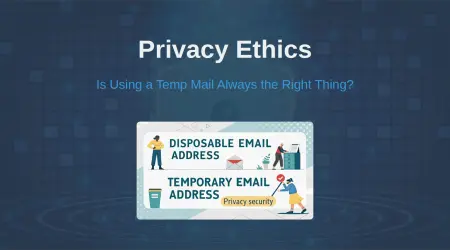
Dr. Reed: A temporary email is a perfect example of ethical pseudonymity. It is not total anonymity, as the service still allows for a verifiable action (receiving a confirmation email). Its ethical value lies in its data minimization function. The user is saying, "I will prove I am a real person for this one transaction, but I refuse to allow this transaction to become a permanent data point in my life." It is a proactive, ethical defense against the aggressive data collection that is now the default setting of the internet.
Part II: The Transition to Malice – Defining the Line
Q: The core question is, when does this ethical good—anonymity—cross the line and become malicious?
Dr. Reed: The transition is defined by intent and consequence. Anonymity itself is morally neutral, like a hammer. It can build a house or be used as a weapon.
The line is crossed when the intent shifts from self-protection to harming others or violating the rights of others.
Dr. Reed (Cont.): The key is the violation of non-maleficence—the principle of doing no harm. If your anonymous action causes financial loss, emotional distress, or physical danger to another party, it is malicious. Using a temporary email to sign up for a newsletter is not malicious; using it to register 100 fake accounts to manipulate a stock price is.
Internal Link Strategy: The use of temporary email for malicious purposes is a direct threat to the digital ecosystem. We have quantified one aspect of this in our research: Original Research: How Quickly Do Phishing Links Land in a New Inbox? [5].
Part III: The Role of the Platform in Mitigating Malice
Q: What ethical responsibility do platform providers, like temporary email services, have to prevent their tools from being used maliciously?
Dr. Reed: They have a profound ethical responsibility, but it must be balanced with the user's right to privacy. The ethical framework here is one of responsible design.
- Data Minimization as a Defense: A service with a Zero-Log Policy [3] is ethically superior because it cannot be compelled to surrender data that would compromise the privacy of legitimate users. By having no data, they are protecting the innocent.
- Proactive Abuse Mitigation: They must implement technical controls like rate limiting and domain rotation [6] to make bulk, automated malicious use (like spam campaigns) economically unfeasible.
- Transparency: They must be transparent about their policies, clearly stating that the service is for privacy and not for illegal activity.
"The ethical challenge for a privacy tool is to be a strong shield for the innocent while being a poor sword for the malicious."
Q: Is there a moral obligation for a service to de-anonymize a user if a crime is committed?
Dr. Reed: The moral obligation is to comply with the law, which is a legal and ethical requirement. However, a service that has ethically designed itself with a Zero-Log Policy ensures that the only data it can provide is the fact that the data no longer exists. This is a crucial distinction. The service is not obstructing justice; it is simply upholding its promise of ephemerality, which is a core ethical commitment to its user base.
Part IV: The Ethical User – Anonymity and Accountability
Q: How can the average user ensure they are using anonymity tools, like temporary email, ethically?
Dr. Reed: It comes down to a simple ethical test: The Golden Rule of Anonymity.
"Do not use anonymity to do anything to others that you would not want them to do to you if you were identifiable."
This means:
- No Harassment: Do not use a temporary email to send abusive or threatening messages.
- No Fraud: Do not use it to defraud a company or individual.
- No Exploitation: Be mindful of the spirit of the service you are signing up for. While bypassing a ToS is not criminal, it is a moral gray area.
Q: In the debate between anonymity and accountability, where should the balance point be?
Dr. Reed: The balance point should be at consequence. Anonymity should be the default for all online interaction because it protects the vulnerable and enables free speech. However, the moment an anonymous action results in measurable, undue harm to another party, the system should be designed to allow for legal accountability.
The temporary email service, by its very design, helps maintain this balance. It provides a layer of privacy for the user's primary identity while ensuring that the ephemeral nature of the address acts as a natural deterrent against long-term malicious use.
Valuable FAQ: Questions on Anonymity Ethics
Q1: Is it unethical for a company to block temporary email addresses?
A: It is a defensive business decision, not an inherently unethical one. Companies are ethically obligated to protect their own resources and users from spam and fraud. However, it is a response to a symptom (abuse) rather than the cause (aggressive data collection). The ethical high ground belongs to the company that minimizes its data collection, thereby reducing the user's need for a temporary email in the first place.
Q2: Does the use of temporary email encourage a culture of irresponsibility?
A: This is a common argument, but I disagree. The use of temporary email is a sign of digital responsibility. It shows the user is actively managing their digital footprint and refusing to be a passive data source. The irresponsibility lies with the platforms that force users into this defensive posture.
Q3: What is the difference between anonymity and pseudonymity?
A:
- Anonymity: No identity is revealed. The user is untraceable. (e.g., using Tor without logging in).
- Pseudonymity: A consistent, non-real-world identity is used. The user is traceable to the pseudonym, but not to their real-world identity. (e.g., a Reddit username, or a temporary email address used for a specific purpose). Temporary email is a form of ephemeral pseudonymity.
Q4: If a temporary email service is used for a crime, is the service provider liable?
A: Generally, no. Under laws like the Communications Decency Act in the US, service providers are typically protected from liability for the content posted by their users. The service is a neutral platform. The liability rests with the individual who committed the crime.
Q5: How can I use temporary email to protect my privacy without being unethical?
A: Use it for its intended purpose: spam avoidance, free trials, and protecting your primary identity from data breaches. Never use it to harass, defraud, or violate the law. If you are using it to bypass a "one-per-customer" rule, understand that you are violating a ToS, which is a moral gray area, but not a criminal act.
Conclusion: The Ethical Shield
The debate over anonymity and malice is a perpetual one, but the ethical use of tools like temporary email is clear. It is a necessary shield for the privacy-conscious user, a practical application of the Right to Be Forgotten, and a sign of a digitally responsible citizen.
The line between ethical use and malicious intent is drawn not by the tool itself, but by the consequence of the user's action. By promoting transparency, adhering to a Zero-Log policy, and educating users on the ethical boundaries, services like TempMailMaster.io can continue to serve as a vital component of a free, secure, and ethically sound internet.
References
[1] Bodle, R. (2012). The Ethics of Online Anonymity or Zuckerberg’s Dilemma. [Source Link: https://www.ohchr.org/Documents/Issues/Opinion/Communications/BodleRobert.pdf] [2] TempMailMaster.io Blog. (2025). GDPR, CCPA, and Temp Mail: The Right to Be Forgotten vs. Service Abuse. [Internal Link: /blog/gdpr-ccpa-temp-mail] [3] TempMailMaster.io Blog. (2025). The Security Audit: What Happens to Your Data When a Temp Mail Expires?. [Internal Link: /blog/security-audit-data-deletion] [4] eSafety Commissioner. (2025). Anonymity and identity shielding. [Source Link: https://www.esafety.gov.au/industry/tech-trends-and-challenges/anonymity] [5] TempMailMaster.io Blog. (2025). Original Research: How Quickly Do Phishing Links Land in a New Inbox?. [Internal Link: /blog/phishing-speed-test] [6] TempMailMaster.io Blog. (2025). The Domain Blacklist Paradox: Why New Temp Mail Domains are Essential. [Internal Link: /blog/domain-blacklist-paradox] [7] Finextra. (2024). The Dual Threat of Anonymity in Cybersecurity Breaches. [Source Link: https://www.finextra.com/blogposting/25616/unmasking-digital-threats-the-dual-threat-of-anonymity-in-cybersecurity-breaches-and-financial-scam] [8] TempMailMaster.io Blog. (2025). The Ultimate Guide to Disposable Email 2025. [Internal Link: /blog/ultimate-guide-disposable-email]
Written by Arslan – a digital privacy advocate and tech writer/Author focused on helping users take control of their inbox and online security with simple, effective strategies.