I Gave My Email to the Wrong Website — Here's What Happened Next
It was a Tuesday afternoon and I needed a specific Excel template for a budget report.
The first Google result led me to a website I didn't recognize. Clean design. Professional logo. A free download button. And a form asking for my name, job title, company, and email address.
I filled it in. I downloaded the template. It was fine — basic, but usable. I closed the tab and didn't think about it again.
That was a mistake. Here's exactly what happened next, over the following six months.
Week 1: The Expected Emails
Within four minutes of submitting my details, a welcome email arrived. Friendly, professional, thanking me for downloading the template and offering a "free consultation call."
I deleted it.
Two days later, a follow-up: "Did you find the template useful? We also offer premium templates for..."
I deleted it.
Day seven: a promotional email about their paid services.
At this point it was mildly annoying but unremarkable. This is what most people expect when they submit their email for a free resource. Standard marketing automation. I'd signed up for this, technically.
What I hadn't anticipated was everything that came after.
Week 3: The First Unknown Sender
An email arrived from a company I'd never heard of. They had my full name — spelled correctly, which I'd entered on the form. The subject line referenced "business productivity tools," which was adjacent to why I'd downloaded the Excel template.
I checked: I had never visited their website. I had never signed up for anything related to their product. I had no prior contact with this company whatsoever.
They had bought my information. From the template website, directly, or through a data broker who'd purchased it from the template site.
I unsubscribed.
Week 6: Four Companies I'd Never Heard Of
By week six, four different companies had emailed that address — none of which I had any direct relationship with. Each had my correct name. Each was targeting me with something loosely related to the topic I'd searched for when I found the template site.
The profile they were working from was clearly the one I'd given the template website: professional, interested in business productivity tools, based in my approximate location.
I unsubscribed from each one.
Month 2: The Phishing Attempt
This is where it got genuinely concerning.
An email arrived that looked, at first glance, like a legitimate security alert from a well-known software company. The sender name was correct. The email formatting was professional. The message said my account had been accessed from an unusual location and asked me to verify my credentials by clicking a link.
I almost clicked it before noticing the sender domain was slightly off — one transposed letter that was easy to miss at a glance.
This was a spear-phishing attempt. It was targeted. It used my name. It referenced a service I actually use. Someone had assembled enough information about me — probably from the enriched profile built around my email address — to craft a convincing and personalized phishing email.
I reported it and moved on. But the close call was unsettling.
Month 3: My Email Appeared on a Data Broker Site
Out of curiosity, I searched my name on a major people-search site. My listing included my full name, approximate age, current city, and — listed under "email addresses" — the exact address I'd used for the template download.
I had never given that website my name or city. They had assembled that profile by cross-referencing my email address against other databases: public records, social media, previous data broker entries.
My throwaway email for a free template had become the linking thread in a profile that included my real-world identity.
I submitted an opt-out request. The listing was removed within 30 days. Three months later, it was back — rebuilt from fresh data sources.
Month 4: The Spike
Something happened in month four that I can only attribute to my data being sold to a new set of buyers. Spam volume roughly tripled over two weeks.
Where I'd been receiving maybe eight to ten unsolicited emails per week, I was suddenly receiving twenty-five to thirty. The topics had shifted — now covering financial services, health supplements, and home security. Nothing to do with business templates.
My enriched profile had apparently been sold to a new category of buyers with different targeting criteria. The email address had outlived its original context and was now just a verified, active address in general circulation.
Month 5: The Lookalike Domain Attack
A more sophisticated attempt arrived: an email from a domain that was registered specifically to impersonate a service I actually use. The email used HTML formatting that was nearly pixel-perfect identical to the real service's communications.
The attack vector was clear: someone had bought a list of active, verified email addresses, cross-referenced them against known service subscriptions using enriched profile data, and sent targeted fake communications to users of that service.
I didn't fall for it. But I could see exactly how someone less attuned to these patterns might.
Month 6: The Final Count
Six months after one sign-up on one website:
- 31 companies had emailed that address
- 3 were the original company or related to my original download
- 28 were companies I'd never interacted with
- 2 were sophisticated phishing attempts using my personal information
- 1 data broker profile had been built and twice rebuilt after removal
- Unsubscribes attempted: 12
- Result of unsubscribing: Temporary — new senders replaced old ones within weeks
The address was effectively compromised as a private communication channel within 90 days of a single sign-up.
What Temp Email Would Have Changed
This is the clearest illustration I can give of why temp email matters.
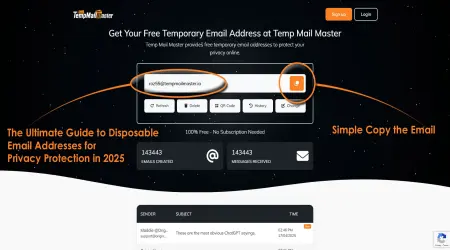
If I had opened TempMailMaster.io before filling in that form:
- The template website would have received a functional email address — their verification system would have worked
- I would have received the download confirmation in the disposable inbox and clicked the link
- The temp inbox would have received the welcome email, the follow-up, and the marketing automation sequence — and then expired
- My real email would never have entered their database
- The 28 unknown companies would have had nothing to purchase
- The data broker profile linking my email to my real-world identity would never have been assembled
- The phishing attempts would have targeted an expired, non-existent address
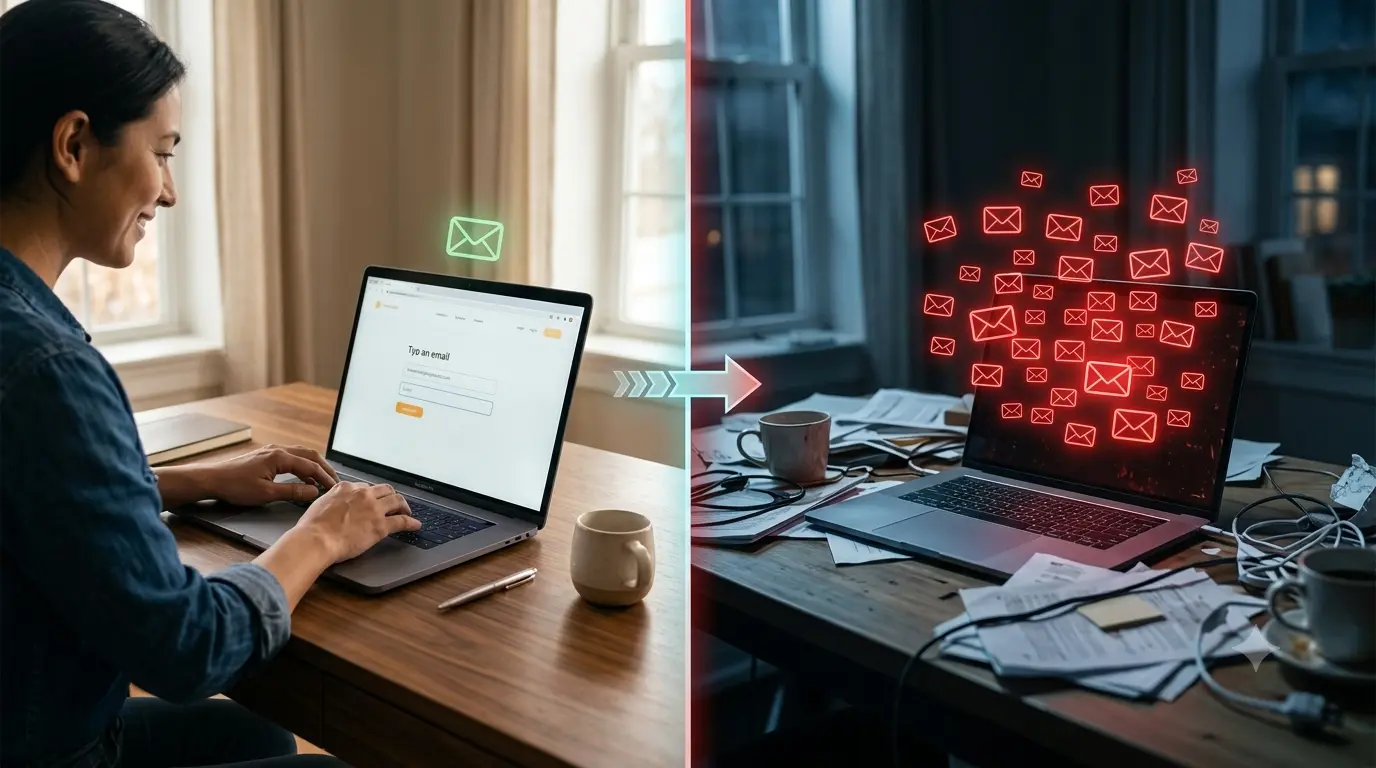
The experiment ends in week one, not month six. And my real inbox stays clean throughout.
The Websites That Do This Most Often
Not every website that asks for your email shares it aggressively. Some have genuine data minimization practices. But certain categories are consistently the worst offenders:
Free resource download sites — template libraries, eBook sites, marketing resource hubs. Their entire model is often built around list building and selling.
Lead generation sites — websites that appear to offer comparison tools, quote generators, or calculators but are primarily designed to capture and sell contact information.
Free trial tools — some SaaS tools have clear data practices. Others sell sign-up data to advertising partners.
Competition and giveaway sites — "enter to win" mechanisms are among the most aggressive data collection tools online.
Content sites in commercial niches — home improvement, financial services, health, travel. High-value niches attract high-value lead buyers.
For a specific breakdown by website category: 10 Websites That Ask for Your Email But Don't Deserve Your Real One
How to Undo the Damage If You've Already Made This Mistake
If you recognize yourself in any part of this story, here's the practical recovery plan:
Check your breach exposure: haveibeenpwned.com shows which databases your email has appeared in.
Search your email on people-search sites: Spokeo, BeenVerified, Radaris, TruePeopleSearch. Submit opt-out requests for any listings you find. Expect to repeat this quarterly.
Change the password on any account using this email if it appeared in a breach. Enable MFA on those accounts.
Stop using the email for new sign-ups. If the address is already heavily compromised, it can't be fully cleaned. Use it only for existing accounts you need to maintain, and use temp email for everything new.
Consider creating a fresh real email for accounts that matter, and migrating your important contacts and accounts to that address over time.
FAQ
Could this really happen from just one sign-up? Yes — and it's not unusual. The template website either sold my data directly or shared it with a broker, who enriched it and sold it to multiple buyers. One source leads to many recipients quickly.
How do I know which websites are safe to give my real email to? You often can't know with certainty. Reading the privacy policy tells you their stated practices — but stated practices aren't always followed. The conservative approach: use temp email for any website you haven't independently verified as trustworthy, and save your real email for established services with clear, legitimate data practices.
Does unsubscribing make things worse? For known senders, unsubscribing removes you from that specific list — which is better than continuing to receive their emails. For unknown or suspicious senders, unsubscribing may confirm your address is active, leading to more targeted contact. Rule: only unsubscribe from senders you recognize.
Is there any way to find out which company sold my email? Generally no — data broker transactions aren't publicly disclosed. The most reliable approach is using unique email addresses (aliases or temp inboxes) for each service, so you can trace which one started the chain.
Should I delete the compromised email address entirely? It depends on how much is tied to it. If you have important accounts, contacts, or subscriptions using that address, deletion is disruptive. A more practical approach: stop using it for new sign-ups, migrate important accounts to a cleaner address over time, and accept that the existing address will continue receiving spam.
References
- Privacy Bee — How data brokers work https://privacybee.com/online-privacy-in-2026-guide/
- Verizon DBIR 2025 — Data breach investigation report https://www.verizon.com/business/resources/reports/dbir/
- Have I Been Pwned — Breach checker https://haveibeenpwned.com
- FTC — Phishing guidance https://consumer.ftc.gov/articles/how-recognize-and-avoid-phishing-scams
- EFF — Surveillance Self-Defense https://ssd.eff.org
- CISA — Email phishing awareness https://www.cisa.gov/phishing
- ENISA — Threat landscape 2025 https://www.enisa.europa.eu/topics/cyber-threats/threats-and-trends
- Abnormal Security — Phishing statistics 2026 https://abnormal.ai/blog/email-security-trends
- Pew Research — Data privacy concerns https://www.pewresearch.org/internet/
- IBM — Cost of a Data Breach 2025 https://www.ibm.com/security/data-breach
Published: June 2026 | Author: Arslan | Category: Email Privacy & Personal Experience