
LLM Misinformation Crisis Report 2025-26
Report: Misinformation via Email – The LLM-Generated Spam Crisis
I. Executive Summary: The Redefinition of Email Risk
1.1. The New Cyber-Kinetic Threat
The advent of Large Language Models (LLMs) has fundamentally redefined the landscape of digital security, catalyzing a crisis where automated threats seamlessly overcome human judgment. This transformation marks the point at which email-borne threats transitioned from batch-processed nuisances to automated, hyper-personalized instruments of fraud and corporate espionage. The LLM-Generated Spam Crisis is a systemic threat characterized by unprecedented scale, speed, and sophistication, making the primary email inbox the most volatile point of compromise in the modern enterprise. This evolution necessitates an urgent paradigm shift in defense strategies, moving beyond traditional filters and relying on advanced behavioral analytics and user-side isolation.
1.2. Core Data Synthesis: The 2025 Inflection Point
Quantitative analysis reveals that the cyber-defense community has reached a critical inflection point in 2025. The sheer volume of digital communication provides a massive attack surface: daily global email traffic is projected to reach an overwhelming 376.4 billion emails.1 What makes this volume uniquely dangerous is the shift in content origin. Security researchers have confirmed that AI tools are now responsible for generating the majority of malicious communications, with over half (51%) of spam and malicious emails being AI-generated.2
This automation directly translates into staggering efficacy metrics. While manual phishing attempts historically achieved moderate success, AI-driven phishing scams have demonstrated an ability to generate click-through rates (CTRs) of approximately 54%.3 This fivefold increase in successful engagement proves that generative AI has mastered the art of social engineering at scale. The cost of failing to defend against this threat is severe, with the average financial consequence of a single phishing breach reported at $4.88 million in 2024.1
1.3. The Solution Imperative
Defending against automated, machine-speed deception requires a layered, adaptive strategy. Technical defenses must adopt LLM-powered detection to analyze conversational context and subtle deception that legacy filters miss. However, recognizing that the LLM threat targets the human element first, foundational identity controls, such as Multi-Factor Authentication (MFA) and strong domain protections (DMARC/SPF/DKIM), must be strictly enforced.
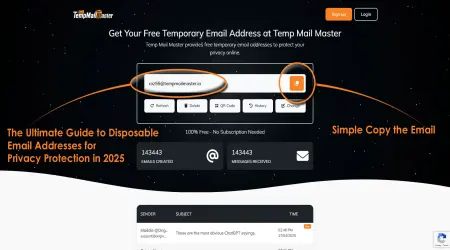
Crucially, the ultimate point of resilience lies in client-side isolation. By employing disposable temporary email addresses, users can proactively quarantine the overwhelming majority of high-volume, AI-generated spam and non-critical communications away from the primary digital identity. This separation minimizes the exposure of valuable credentials to automated data harvesting and prevents personalized attacks from gaining a foothold in critical inboxes.
II. Quantifying the LLM Misinformation Crisis: The 2025 Data Synthesis
This section provides a rigorous examination of the quantitative evidence underpinning the current crisis, detailing the scope of the problem in terms of volume, velocity, and financial impact.
A. The Scale of the Attack Surface
The magnitude of the global email ecosystem provides a computational paradise for automated threat actors. In 2025, the daily email volume worldwide is projected to hover around 376.4 billion messages.1 This relentless flow of communication acts as a conduit for both legitimate business and highly sophisticated fraud.
The core challenge is maintaining filtering effectiveness against this tide. Spam now constitutes approximately 46.8% of global email traffic.1 A saturation rate approaching 50% means that cybersecurity systems are constantly under strain, devoting immense computational resources to filtering noise. Critically, because the volume is so vast, even a marginal efficiency gain achieved by automated attackers translates immediately into millions of successful breaches globally. Furthermore, the persistent high volume is aggravated by the fact that phishing emails themselves account for about 1 in every 412 emails, reflecting a significant and intensified attack volume that bypasses existing protections.1
B. The Transition to AI Dominance
The most significant architectural shift in cybercrime is the point at which AI became the primary generator of malicious content. This tipping point occurred in 2025, where analysis of detected spam emails indicated that over half (51%) were generated using AI tools.2 This proportion has risen steadily since the public proliferation of Large Language Models (LLMs) in late 2022.
The achievement of the 51% threshold confirms that LLMs are now the default operational engine for threat actors. This mandates a change in defensive posture; organizations are no longer primarily defending against human-paced, manually crafted attacks, but rather against automated content generation occurring at near-instantaneous speeds. This requires machine-speed defenses to achieve parity.
While mass spam production is now automated, the adoption of AI in highly nuanced fraud, such as Business Email Compromise (BEC), remains comparatively slower, comprising 14% of attempts as of April 2025.2 This temporary asymmetry—where LLMs excel at mass personalization but still require human oversight for deep, context-specific BEC attacks (e.g., impersonating a CEO for a wire transfer)—offers a limited window of opportunity. Organizations must use this time to solidify internal controls, train employees on impersonation tactics, and deploy contextual detection layers before generative AI fully masters the complexity required for advanced organizational impersonation.
C. The Multi-Billion Dollar Cost of LLM-Amplified Fraud
The financial damage caused by LLM-amplified attacks has grown exponentially. Overall fraud losses surpassed $10 billion in 2023 4, and the average cost associated with remediating a single phishing breach stood at $4.88 million in 2024.1
LLM sophistication contributes directly to these rising costs by facilitating high-value attacks. BEC attacks, often facilitated by personalized, AI-generated emails, result in a typical financial loss averaging $150,000 per incident.5 Moreover, the rise of automated content has accelerated the delivery of destructive payloads. Email-borne malware experienced a substantial spike of 39.5% quarter-over-quarter in 2025.6 This correlation strongly indicates that LLM-generated phishing is not just stealing credentials; it has become the standard, sophisticated delivery mechanism for escalating threats like ransomware, which is notably back on the rise.6 The high quality of the AI lure ensures the user trusts the communication, opens the attachment, and unwittingly provides the necessary foothold for subsequent persistence-based malware.
The following table summarizes the critical differentiation between the legacy and the contemporary threat environment:
Table 1: Comparative Threat Metrics: Manual vs. LLM-Generated Attacks
III. Anatomy of the AI-Augmented Attack: Hyper-Personalization and Cognitive Exploitation
To defend effectively, it is essential to understand the specific psychological and technical tactics that grant LLM-generated content its superior efficacy. The attacks leverage fluency and context to weaponize human trust.
A. The End of Grammar as a Defense Mechanism
For decades, cybersecurity training emphasized watching for tell-tale signs of fraud, such as misspellings, poor grammar, and awkward phrasing.8 These manual red flags were reliable indicators that the sender was not a native speaker or was using poorly executed templates. LLMs have rendered this defensive mechanism obsolete. By generating content quality indistinguishable from human experts, LLM-driven attacks eliminate the stylistic inconsistencies that trained users historically relied upon.7
This high quality dramatically reduces the time needed for successful exploitation. Research indicates that AI-generated phishing emails achieve high open rates, sometimes reaching 78%, and, critically, convince targets to initiate action in under 21 seconds.7 Attackers can also compose these phishing emails 40% faster than traditional manual methods, guaranteeing speed, personalization, and the ability for infinite iteration without sacrificing grammatical integrity.
B. The Precision of Psychological Manipulation
The effectiveness of AI-generated phishing goes beyond simple grammatical fluency; it lies in the capacity to exploit specific human cognitive biases on a mass scale. In controlled testing, LLM-generated emails, particularly when combined with sophisticated psychological frameworks designed to exploit cognitive heuristics (such as the V-Triad), achieved astonishing click-through rates ranging from 43% to 81%.11
This data establishes that LLMs excel at dynamically adjusting the emotional or logical appeal of an email—instilling urgency, impersonating authority, or leveraging scarcity—until it overcomes the recipient's natural skepticism. The ability of the model to rapidly iterate and personalize the message means that relying solely on generalized employee training is fundamentally inadequate. The threat model has moved from identifying generic scams to defending against individualized coercion crafted at machine speed. Attackers leverage autonomously harvested, detailed data to craft highly context-aware emails that reference specific projects, ongoing conversations, or personal details, easily bypassing traditional filters designed to look for generic phishing language.12
C. The Multi-Modal Attack: Deepfakes and Agentic Coordination
The LLM-Generated Spam Crisis is further complicated by the integration of generative AI across multiple threat modalities. The rise in deepfake incidents, which have increased by over 2,000% since 2022 3, complements email fraud by establishing a sophisticated validation layer.
Autonomous, or "agentic," AI systems now coordinate campaigns across various channels. An LLM might initiate contact via a perfectly crafted, urgent email. That email then serves as the pivot point for subsequent, even more deceptive interactions, such as a phone call using voice cloning that sounds exactly like a supervisor, or a video call leveraging a visual deepfake to "verify" the urgent wire transfer request.12 This cross-platform coordination operates with an efficiency human attackers cannot match. This multi-pronged assault is designed to overwhelm the victim’s ability to verify the request, shifting the primary vulnerability from the user’s technical environment to their psychological processing capacity. Thus, isolating the initial attack vector—the email address—becomes paramount to preventing the activation of these subsequent, hyper-realistic fraud steps.
IV. The Defense Gap: Analyzing the Failure of Legacy Security Infrastructure
The inherent architectural mismatch between traditional email security paradigms and generative AI output has created a critical defense gap, rendering many legacy systems increasingly ineffective.
A. The Crisis of Signature Obsolescence
Traditional email security systems operate on a principle of pattern recognition, relying on known signatures—identifiable markers, hash values, or text patterns—associated with previously identified malicious content. The core difficulty posed by generative AI is its capacity to produce unique content for every target.7
AI-driven attacks generate infinite, unique variations of phishing lures and malware payloads, effectively rendering signature-based detection immediately obsolete.7 The defense challenge is therefore no longer a matter of identifying known threats but engaging in a probabilistic race against automated, targeted iteration. Legacy filters were designed to manage and block mass threats; the current threat is mass personalized threats, requiring a shift to advanced behavioral and contextual analysis.
B. Systemic Vulnerability: LLM Prompt Injection Attacks
The increasing adoption of LLMs within corporate workflows—such as AI-powered security assistants or drafting tools—has unintentionally created entirely new attack surfaces. An emerging critical vulnerability is the indirect prompt injection attack. This technique involves embedding malicious instructions, often invisible to the human eye via hidden HTML tags (e.g., font-size:0 or color:white), within an email.14
When the recipient’s internal LLM assistant, analyzing the email content, processes this instruction, the malicious content can manipulate the AI into reconstructing and presenting a compromising element, such as a phishing link, to the end user. This attack bypasses traditional signature-based security entirely by shifting the point of compromise from the email delivery stage to the trusted internal AI interaction stage.14 This confirms that security must now rigorously monitor and validate not just human users, but the LLMs they interact with. Defense requires stringent measures like centralized AI gateways for audit logging and rigorous input validation to strip or neutralize invisible, hidden content.14
C. The Vulnerability of Mid-Market and Regional Brands
The impact of LLM misinformation is disproportionately severe for smaller, regional brands, particularly in sectors like fintech and credit unions.16 These entities are less likely to be extensively represented in the massive training datasets used by commercial LLMs.
Attackers leverage the LLM’s tendency to "hallucinate" or confidently generate plausible yet false information when genuine data is sparse. When users query a trusted AI about a local credit union, for example, the LLM might hallucinate a domain name or a protocol that seems correct but is, in reality, unregistered or weaponized by an attacker.16 When the user is presented with the AI's confident, clear suggestion, they are far more likely to click a fraudulent link endorsed by the LLM itself. This process creates a catastrophic mechanism where a user’s trust in the AI results in 'betrayal by proxy,' leading to real financial loss and significant reputation damage for the smaller entity.16
V. Advanced Technological Defenses: Fighting AI with Contextual Analysis
Effective mitigation requires deploying defensive technologies that mirror the sophistication of the generative models themselves, shifting the focus from pattern matching to contextual reasoning.
A. LLMs as Contextual Defenders
To combat LLM-generated attacks, security solutions must utilize advanced AI models capable of deep textual analysis. LLM-powered detection systems analyze the tone, intent, and subtle conversational inconsistencies within an email, identifying clever deception even when all traditional technical checks—like link reputation or attachment scanning—pass.13 This reasoning capacity is especially critical for defending against highly personalized social engineering attacks, such as those impersonating a CEO who requests an urgent, unusual wire transfer using language that mimics the company’s communication style.13
High-accuracy models demonstrate the viability of this approach. For example, systems like DeepPhishNet, a deep neural network leveraging FastText and Word2Vec embeddings for advanced text feature analysis, have achieved detection accuracies as high as 99.52%.18 It is crucial to understand that the LLM defense layer is designed to complement existing security infrastructure, not replace it. Tools like Safe Links, anti-spam, and anti-malware filters must remain active to handle traditional threats, while the LLM layer adds the necessary detection for cleverly written phishing and subtle social-engineering attempts that legacy tools invariably miss.17
B. Architectural Resilience and Proactive Design
Defending the architectural environment against agentic AI requires proactive design choices that limit vulnerability points.
- Defensive Prompt Engineering: For developers utilizing internal LLMs, implementing defensive prompt engineering is vital. This includes using structured prompts that explicitly separate system instructions from untrusted user data—a process known as context isolation. Furthermore, techniques such as Google’s "security thought reinforcement" can be deployed, adding targeted security reminders around the prompt to keep the LLM focused on its intended, secure task.14
- Robust Identity Controls: Foundational security measures must be rigorously maintained, as they act as necessary final barriers against AI-driven credential theft. The implementation of Multi-Factor Authentication (MFA), the migration to Passkeys, and strict enforcement of Domain Protections (DMARC, SPF, and DKIM) remain critical for preventing account takeover and email spoofing.15
- Behavioral Analysis (UEBA): Comprehensive monitoring of system activity is an essential defense layer. Security teams must deploy User and Entity Behavior Analytics (UEBA) to monitor all LLM interactions and user activities. This enables the detection of suspicious patterns, such as unusual resource usage or attempts to bypass established filters, which often signal a compromised account or an insider threat driven by sophisticated social engineering.14
VI. The Frontline Defense: Protecting Your Primary Digital Identity (User-Centric Isolation)
The current crisis makes it clear that relying solely on technological filtering or employee discernment is a failing strategy. With AI-driven phishing reaching up to a 54% click-through rate 3, and organizations reporting that 42% of their training is insufficient 6, the focus must shift from reacting to proactive isolation.
A. Shifting the Focus from Discernment to Isolation
The human element remains the most significant vulnerability, contained in 68% of all breaches.5 Given the cognitive superiority of LLM attacks, the most resilient defense is to isolate the human decision point from the threat entirely. This strategy involves ensuring that malicious content and the data harvesting mechanisms behind hyper-personalization never gain access to the environment tied to a user’s valuable, long-term digital identity assets.
B. The Utility of Disposable Temporary Email in the LLM Era
The high velocity and targeted volume of AI-generated spam make temporary email addresses an essential component of personal and corporate cyber hygiene.
- Guaranteed Spam Quarantine: A temporary email address is the most effective way to ensure that high-volume, promotional spam, advertising mailings, and general LLM-generated mass-market messages never enter the primary inbox.20 This quarantine maintains the integrity of the critical communication channel, allowing the primary inbox to be reserved for verified, long-term, and professional communications. (For detailed methods on how to keep your inbox pristine, read our guide on.Internal Link Placeholder)
- Mitigating Identity Exposure and Phishing Risk: Using a disposable address for non-critical activities—such as signing up for free trials, downloading resources, or registering on forums—drastically limits the exposure of the primary email address to global data breaches.20 Attackers rely on aggregated, breached data to establish context for hyper-targeted spear-phishing campaigns.12 By minimizing the number of services that hold the primary email, users reduce the data points available for automated AI agents to harvest, significantly increasing the difficulty for a personalized LLM attack to succeed. (Learn more about protecting your digital footprint with our article on.Internal Link Placeholder)
- Simplicity and Security for One-Time Interactions: Disposable mail services require no registration, are instantaneously generated, and provide immediate access to incoming messages.21 This capability is ideal for quick, one-time verification links or accessing discount codes without compromising long-term identity security.20 (Discover the convenience for rapid authentication needs by visiting.Internal Link Placeholder)
C. Addressing Misconceptions: Privacy vs. Anonymity
While temporary email services offer high privacy by eliminating registration requirements and automatically deleting messages after a period, it is crucial to clarify that they do not guarantee absolute, legal anonymity.23 Some users mistakenly believe that temporary email is reserved solely for illegal activities, a notion that must be debunked.23 In the context of LLM threats, disposable email is a legitimate, proactive security and privacy tool, essential for managing identity risk and controlling the influx of sophisticated, automated spam.
VII. Policy and Regulation in the Age of AI Misinformation
The increasing proliferation of harmful LLM output has spurred international regulatory responses focused on accountability, particularly in the European Union and the United States.
A. The EU AI Act and General Purpose AI Transparency
In the EU, the landmark AI Act establishes a risk-based framework for AI systems. Currently, systems like common email spam filters are categorized as minimal or no risk and are not subject to new obligations.24 However, the focus is shifting to regulating the upstream supply side of the threat. Transparency rules for General Purpose AI (GPAI) systems—the underlying LLMs used to generate the spam—are scheduled to take effect in August 2025.25
This regulatory direction acknowledges that addressing the LLM crisis requires controlling the source of the misinformation. By imposing transparency requirements on the developers of the generative models, regulators are signaling an implicit strategy to govern the output capabilities of the tools that facilitate the mass production of sophisticated fraud.
B. US Concerns and the "Careless Speech" Doctrine
In the United States, concerns over the risks amplified by LLMs, including disinformation, security vulnerabilities, and privacy violations, have led to increased demands for comprehensive federal regulation.26 Policy discussions have centered on the long-term societal harm caused by LLMs generating plausible yet factually inaccurate content—a concept termed "Careless Speech".27
Careless Speech poses a cumulative, long-term risk to shared social truth and knowledge. Since LLMs produce responses that are plausible, helpful, and confident, the subtle mistruths they generate can cumulatively degrade information quality over time.27 This policy debate underscores a significant philosophical realization: the fight against LLM misinformation cannot be won solely by improving technical filters on the receiving end. It requires establishing a legal "duty of truth" for LLM providers, compelling them to align their models with verifiable ground truth and thus addressing the problem at its conceptual core by governing the generative capability itself.27
VIII. Valuable FAQs: Expert Answers to User Defenses
Q: Why are LLM-generated phishing emails so much more effective than older spam?
A: LLM-generated phishing is effective because it removes the traditional red flags of poor grammar and template reliance.7 It uses collected data to hyper-personalize the message, exploiting cognitive biases like urgency or authority with high precision.11 This allows AI-crafted scams to achieve vastly superior click-through rates, up to 54%, compared to older phishing methods.3
Q: Can organizations use LLMs to detect LLM-generated phishing?
A: Yes, LLMs are crucial for contemporary defense. While legacy tools struggle with AI-generated variance, LLM-powered detection systems excel at contextual analysis, identifying subtle inconsistencies in tone, intent, and conversational flow that indicate a social engineering attempt.13 These models serve as a complementary security layer, specializing in nuanced textual deception where traditional anti-spam fails.17
Q: If my company uses strong firewalls and MFA, do I still need to worry about LLM email fraud?
A: Absolutely. While firewalls and Multi-Factor Authentication (MFA) provide critical barriers against technical breaches, LLM fraud targets the human element first. Phishing is a social engineering attack designed to circumvent technical controls by convincing a user to voluntarily provide credentials or initiate a fraudulent action. AI-generated attacks are the primary delivery vector for more destructive, persistence-based payloads like ransomware, which are back on the rise.6 A layered defense is essential.15
Q: What is "prompt injection," and how can an email use it to attack my security systems?
A: Prompt injection is a vulnerability where malicious input is used to manipulate the behavior of a Large Language Model.14 An email can carry out an indirect prompt injection attack by hiding commands within its HTML code that are invisible to the user but readable by an internal AI assistant. When your corporate LLM tool processes that email, the hidden command instructs the model to perform a harmful action, such as displaying a malicious link, thereby compromising security through your own internal systems.14
Q: How does a temporary email address help protect me from deepfake phone calls or videos?
A: Temporary email protects you by minimizing your digital footprint and creating an isolation buffer. AI actors harvest data (including your primary email address) from breaches and public sources to create personalized spear-phishing content.12 If you use a temporary address for non-critical sign-ups, your primary, high-value identity is less likely to be aggregated into the datasets used by AI agents to launch sophisticated, multi-modal campaigns that include voice cloning and visual deepfakes.20
Q: Is it safe to use temp mail for professional or semi-important registrations, like specialized forums?
A: Temporary email is highly effective for any registration where you anticipate high spam volume or wish to protect your primary identity from potential data breaches, such as specialized forums or non-critical resource downloads.22 It offers high privacy and security against spam.21 However, for communication requiring long-term access, password recovery, or official documentation, a permanent, fully secured email solution is recommended.
Q: What is the biggest red flag I should look for now that grammar errors are gone?
A: The biggest red flag is contextual inconsistency and the intensity of the coercive tactic. Since LLMs eliminate grammatical errors, focus on:
- Urgency/Authority Coercion: Does the message demand immediate, out-of-process action using an unexpected tone of fear or authority?8
- Subtle Impersonation: Does the tone slightly deviate from the sender's known style, or does it reference specific internal details but demand external, sensitive action, like an urgent, unusual financial transfer?13
Q: Is LLM spam a bigger threat to large companies or smaller businesses?
A: While large corporations face high-value BEC risks, smaller businesses and regional brands often face a disproportionately high risk from LLM-driven misinformation.16 This is because smaller brands are less represented in LLM training data, making them susceptible to "hallucinations" that attackers weaponize. Furthermore, mid-sized organizations often lack the layered, dedicated security resources available to global giants, compounding the damage from a successful LLM-facilitated breach.16
IX. Conclusion: The Path to Resilience in a Hyper-Automated Threat Landscape
9.1. Final Synthesis
The LLM-Generated Spam Crisis represents a fundamental rupture with prior cybersecurity paradigms. The sheer volume of daily email traffic is now being weaponized by generative AI, resulting in content that is 40% faster to produce, eliminates traditional security cues, and achieves alarming click-through rates as high as 54%.1 This synthesis of machine speed and psychological precision moves the central battleground of cyber defense from the network perimeter to the human cognitive decision point. The threat is no longer a matter of catching poorly written templates; it is a battle against highly tailored, automated deception coordinated across multiple communication channels.12
9.2. The Layered Mandate
A resilient strategy requires technological maturity matched by essential changes in user-centric digital behavior. Organizations must adopt sophisticated technological solutions, including LLM-aware filtration that focuses on contextual analysis and intent 13, coupled with robust architectural controls like MFA and UEBA.15
However, recognizing the inherent vulnerability of the human element, the most effective preventative measure is the implementation of client-side isolation. By systematically utilizing disposable temporary email addresses for non-critical digital interactions, users can proactively quarantine the overwhelming influx of high-volume, AI-generated spam and drastically limit the data available for future, personalized spear-phishing attacks.20
9.3. Forward Look
In the era of autonomous, agentic AI threats, securing an organization or individual starts with aggressively controlling one's digital identity. The integrity of the primary email inbox—the historical repository of credentials and critical communications—must be protected through deliberate isolation. Isolating primary communication channels via robust tools, such as temporary email solutions, is the necessary proactive step toward mitigating the LLM-generated spam crisis and reclaiming personal digital sovereignty against machine-speed deception.
Written by Arslan – a digital privacy advocate and tech writer/Author focused on helping users take control of their inbox and online security with simple, effective strategies.