What Is Temporary Email? How It Works and Why You Should Use It
Written by Arslan · Reviewed by TempMailMaster Editorial Team
Research references: FTC, CISA, NIST privacy and security guidance.
Last updated: July 2026
You're three steps into downloading a PDF, and the form wants an email address before it'll let you through. You don't want the newsletter that's obviously coming next, and you'd rather not hand over the inbox you actually check every day for something you'll open once. That gap — needing an email address without needing everything that comes with giving out your real one — is exactly what a temporary email exists to fill.
What a temporary email actually is
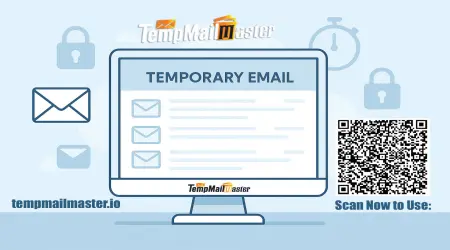
A temporary email — also called temp mail, disposable email, or a burner address — is an inbox that exists for a short window, usually minutes to a few days, and then disappears. It isn't a special kind of email technically; it's a normal address created on a domain a service like TempMailMaster.io controls, handed to you instantly, and discarded once it's served its purpose.
The difference from your regular inbox isn't the technology — it's the intent. A temp mail address is built to be used once and forgotten, not maintained.
How a temporary inbox works, step by step
- You land on the page — no account, no registration
- An address is generated automatically and shown to you
- You use that address anywhere a signup form asks for one
- Any confirmation, verification, or promotional email lands directly in the inbox on the page
- After the set window passes, the address and everything in it disappear for good
That last step matters more than it sounds. Once the address expires, there's no recovery — not for you, not for the site you signed up with. Treat it as one-way.
Need one right now?
Generate a disposable email instantly on TempMailMaster — no signup required.
What it's genuinely good for
- Keeping a one-time signup from turning into a permanent stream of promotional email
- Trying a service or free trial without deciding upfront whether you'll want to keep it
- Signing up on a site you don't yet trust, without linking that account to your real identity
- Testing signup and verification flows without cluttering a personal inbox
We go deeper into these trade-offs — including what you give up in exchange — in our full breakdown of the benefits of disposable email, and when not to use one.
Who actually uses temporary email
Developers and QA engineers lean on it to test signup and verification flows without spinning up dozens of real inboxes — our guide to integrating temporary email into testing workflows covers that in more depth. Researchers and students use it for one-off access to papers, tools, or datasets. And plenty of everyday users reach for it simply because they'd rather not add another account to services already tracking their real address.
When not to use a temporary email
- Banking, financial platforms, and anything requiring identity verification
- Any service you intend to keep long-term — once the address expires, so does your way back in
- Anything involving sensitive personal, medical, or financial information
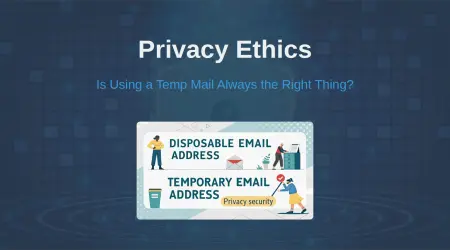
There's also a line between using temp mail to protect your privacy and using it to get around a rule a service is entitled to enforce. Our piece on when temp mail use crosses an ethical line goes into that distinction in more detail.
What temporary email doesn't protect you from
A temporary address hides your email identity — nothing more. It doesn't hide your IP address, payment details, or anything else you type into the same site. A meaningful share of services also block known disposable domains outright, so it won't always be accepted in the first place.
It doesn't make a phishing attempt any safer to click, either — a temp inbox has no spam filtering of its own, so what lands there is often more raw and unfiltered than what reaches a mainstream provider's inbox. Our guide to spotting phishing attempts is worth reading regardless of which inbox you're using.
And for the accounts that do stay on your real email long-term, no amount of inbox strategy replaces a strong, unique password and two-factor authentication — those guides cover what actually holds up. For a closer look at what can go wrong with free services specifically, our breakdown of the hidden security risks of free temp mail services is worth a read before you rely on one regularly.
FAQ
Is temporary email really anonymous?
Not completely. It keeps your email identity separate from a signup, but it doesn't hide your IP address, device information, or anything else the site collects independently. Think of it as reducing one specific kind of exposure, not disappearing entirely.
How long does a temporary email address last?
It depends on the service — some expire in minutes, others last a few days. Whatever the window is, treat it as final: once it passes, the address and everything sent to it are generally gone for good.
Can I use a temporary email for important accounts?
No — avoid it for anything you'll need to recover, log back into, or trust long-term. Once the address expires, so does your only way to receive a password reset or account notice.
What happens to messages after the inbox expires?
They're deleted along with the address. There's typically no way to retrieve a message once the expiration window has passed, so anything you might need later should be saved elsewhere first.
Is using temporary email against the law or a site's terms?
Using one to protect your privacy on a low-trust signup isn't illegal or unusual. Where it gets murkier is using one to repeatedly get around a rule a service is entitled to enforce, like claiming a one-per-person trial more than once — that's a misuse of the tool, not a legal gray area with the tool itself.
Do all websites accept temporary email addresses?
No. A large share of signup forms check incoming addresses against lists of known disposable domains and block or reject them, which is why a temp address sometimes won't work at all.
The bottom line
A temporary email isn't a replacement for your real inbox — it's a buffer for the signups that don't deserve a permanent spot in it. Used that way, it does exactly one job well: keeping the accounts you don't care about from ever becoming the problem of the ones you do.
For anything you'd actually miss losing access to, your real email, a strong password, and two-factor authentication are still doing the real work.
References
Federal Trade Commission — Data Breach Consumer Guidance: consumer.ftc.gov/search-terms/data-breach
Cybersecurity and Infrastructure Security Agency (CISA) — Phishing Guidance: Stopping the Attack Cycle at Phase One: cisa.gov/resources-tools/resources/phishing-guidance-stopping-attack-cycle-phase-one
National Institute of Standards and Technology (NIST) — Digital Identity Guidelines (SP 800-63): nist.gov/identity-access-management/projects/nist-special-publication-800-63-digital-identity-guidelines
Electronic Frontier Foundation (EFF) — Privacy: eff.org/issues/privacy