Digital Identity Layering Strategy
The Digital Identity Layering Strategy: Segregating High-Value Accounts for Immutable Security
The modern digital ecosystem demands a fundamental shift in personal security protocols. No longer can individuals rely on single passwords or simple multi-factor authentication (MFA) to safeguard their digital lives. With global cybercrime losses soaring and organizational data breaches becoming an expected operational certainty, the security paradigm must evolve from single-point defense to architectural resilience. This report details the implementation of the Digital Identity Layering Strategy, a framework that adapts enterprise-grade cybersecurity principles—specifically Separation of Duties (SoD) and Zero Trust Architecture (ZTA)—to segment and protect high-value personal accounts using strategic account segregation and disposable email addresses.
Section 1: The Escalating Crisis of Identity Compromise
The decision to adopt a layered defense perimeter is not optional; it is a necessary response to the unprecedented volume and sophistication of modern cyber threats. The financial and personal impacts of compromised identity have reached crisis levels, demonstrating that the traditional "flat" identity structure—where a single email address links all facets of a user’s life—is structurally unsound.
1.1. The New Economics of Digital Risk: Unpacking 2024/2025 Fraud Data
Statistical evidence confirms that personal data leakage is rampant and highly costly. In the United States alone, the losses reported to cybercrime reached a staggering $16.6 billion in 2024.1 This massive financial drain underscores the high stakes involved in digital defense.
For organizations, the average total cost of a data breach is approximately $4.88 million globally.2 This institutional vulnerability has a direct consequence for the consumer: every time a user signs up for a service, they are entrusting their digital identity to an entity that, statistically, faces a significant risk of compromise. For example, reports indicated that 90% of the world's top energy companies experienced data breaches stemming from third-party breaches.3 This vulnerability, stemming from interconnected digital infrastructure, means that individual security habits cannot compensate for systemic organizational failures.
Furthermore, the longevity of an attack significantly increases its financial and operational impact. Breaches that require over 200 days to identify and contain cost, on average, $1.39 million more than those resolved quickly.2 This data highlights the pervasive and long-lasting nature of identity compromises. The core issue driving this is the attacker’s reliance on already compromised accounts. Analysis of incident entry points revealed that 30% of all incidents in 2024 were linked to attackers abusing valid accounts, indicating that they are simply logging in using stolen credentials rather than relying on complex intrusion techniques.4 If a user maintains a flat identity across multiple platforms, a data leak from a single low-security environment instantly provides the key to every subsequent account via credential stuffing and account abuse.5
1.2. The AI Factor: Exponential Growth in Sophisticated Fraud
Advancements in Generative AI (GenAI) have fundamentally lowered the barrier to entry for cybercriminals, enabling large-scale, highly personalized attacks that bypass traditional security awareness training.
The growth of synthetic identities is a critical area of concern. Driven by new technologies, AI-generated fraud is now a key operational challenge, recognized by 70% of companies.6 Synthetic identities—often composites of real and fake data—account for an estimated 85% of financial fraud cases, marking it as the fastest-growing fraud category globally.6 This level of sophistication renders simple knowledge-based verification (KBV) ineffective and mandates robust, layered verification controls.
GenAI also facilitates highly personalized fraud campaigns, commonly known as spear-phishing.7 An attacker no longer needs to send mass, generic emails; they can craft targeted messages that mimic trusted communication, increasing the likelihood of successful credential theft. This evolution of the threat landscape proves that security must transition from "preventing leaks" to an architectural strategy designed to "mitigate the impact of inevitable leaks." The Layering Strategy ensures that even if compromised credentials from a perimeter account are stolen, they grant zero access to the Inner Core of critical assets.
Section 2: Defining the Digital Identity Layering Strategy (The Framework)
The Digital Identity Layering Strategy is the translation of corporate cybersecurity best practices into an effective personal defense architecture. At its heart lies the principle of Personal Separation of Duties (P-SoD).
2.1. Adaption of Enterprise Security: Personal Separation of Duties (P-SoD)
The enterprise security principle of Separation of Duties (SoD) is foundational to mitigating insider threats and reducing the risk of accidental or malicious activity involving mission-critical data.9 SoD dictates that critical responsibilities must be divided among multiple individuals or systems to prevent any single entity from executing a critical process from start to finish without oversight.10
Applying this concept to individual digital identity means recognizing that using a single primary email address for all activities violates this crucial architectural mandate. By using one email for both sensitive financial accounts and low-risk newsletter sign-ups, the user grants a single point of entry, allowing an attacker to escalate privileges from a low-risk site breach to a high-risk financial takeover.9 The objective of P-SoD is to establish non-overlapping privileges, ensuring that the compromise of one identity artifact (such as a temporary email) cannot authorize actions in another, high-value layer.12
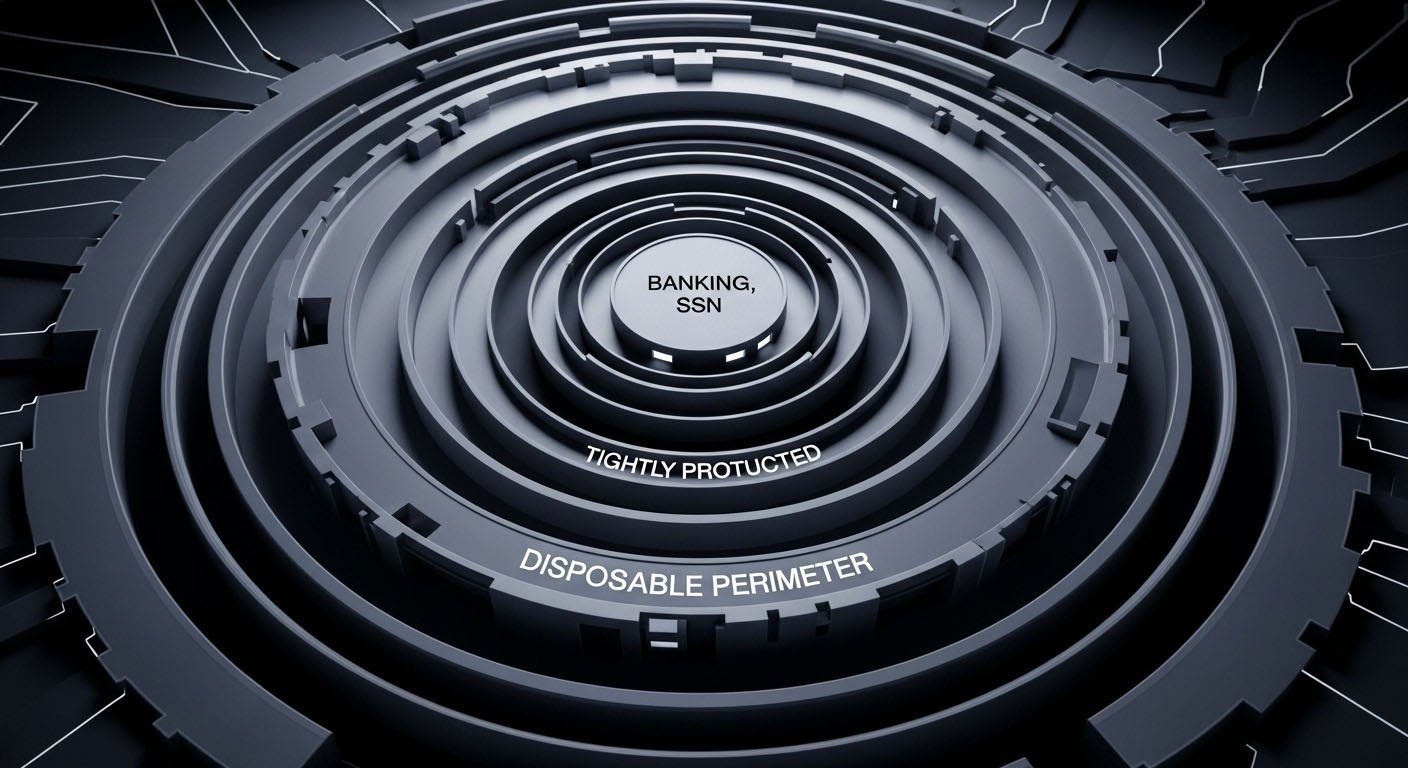
2.2. The Three Concentric Circles of Digital Defense
A robust Digital Identity Layering Strategy establishes three distinct, protected, and independent layers for digital accounts, categorized by the sensitivity and consequence of compromise.
Table 1: Digital Identity Segregation Model: High-Value vs. Disposable Accounts
Layer 1: The Inner Core requires the highest possible assurance level, focusing on mechanisms that are phishing-resistant and cryptographically secure. This layer holds the keys to financial sovereignty and civic identity. The resources here correlate closely with the standards set for Identity Assurance Level (IAL) 3 in enterprise security, demanding hardware-backed verification.13 The email address associated with Layer 1 must be kept strictly secret and never used for marketing, public forums, or any Layer 2 or Layer 3 activity.
Layer 2: The Trust Layer accommodates necessary high-value interactions that may not support hardware security keys but still demand robust authentication. This layer requires multi-layered verification against several information sources (e.g., strong passwords coupled with authenticator app MFA).14
Layer 3: The Disposable Perimeter acts as the sacrificial boundary. Its explicit function is to absorb the inevitable barrage of spam, marketing trackers, data collection, and minor data leaks without compromising the user’s core identity.5 The critical distinction in this framework is that this layer must be managed using dynamic, temporary, or disposable email addresses (DEAs) that are structurally disconnected from the Inner Core.
Section 3: Architecting the Inner Core's Immutable Defenses
Protecting the Inner Core (Layer 1) requires moving beyond security practices that rely on human diligence, which can be overcome by social engineering, toward mechanisms rooted in cryptographic proof.
3.1. Phishing Resistance: The Mandate for Layer 1
Compromised credentials remain the single most significant factor in long-lasting security incidents. Breaches involving stolen or compromised credentials took the longest time to resolve—averaging a 292-day lifecycle from initial compromise to containment.2 This demonstrates that the attacker's primary vector is credential theft, which standard forms of MFA (like SMS codes) often fail to mitigate effectively due to vulnerabilities like SIM swapping.
In response to pervasive threat environments, federal security strategies, such as the mandated transition to Zero Trust Architecture (ZTA), require that all authentication shall be phishing resistant.16 The highest standard available to meet this mandate for individual users is the implementation of hardware security keys (FIDO keys).
FIDO2 and Passkeys, which are based on the FIDO protocol, provide phishing-resistant verification.17 Unlike traditional MFA, FIDO keys use cryptography tied to a specific domain. When logging in, the key verifies that the website requesting access is the legitimate site, making it impossible for a man-in-the-middle phishing site to trick the key into releasing the authentication token. This fundamental shift in authentication mechanics prevents the most effective form of identity compromise. FIDO2 keys function as a second factor for 2-Step Verification and are increasingly used to create Passkeys, allowing users to bypass traditional passwords entirely.17
3.2. Step-by-Step Guide to Hardening the Inner Core
Effective layering requires meticulous adherence to provisioning and management protocols, mirroring the rigor of corporate Identity Lifecycle Management (ILM).16
- Auditing and Classification: The first step involves an exhaustive review of all current online accounts. Each account must be rigorously classified according to the three-tier Segregation Model (Table 1).21 A common failure point is the tendency to grant overly broad permissions or misclassify accounts based on temporary convenience rather than permanent risk.22
- Dedicated, Secret Email Establishment: The email address linked to Layer 1 (banking, investments, master password vault) must be physically and logically separated from all other communication streams. This segregated email must never be used for any public-facing or marketing activity.23
- Hardware MFA Deployment: Acquire FIDO2 security keys (USB or NFC) and register them across every Layer 1 account that supports the protocol.20 Due to the high consequence of losing the sole authentication device for critical accounts, it is imperative to establish redundancy by registering at least two physical keys: one for daily use and one stored securely off-site for emergency recovery.
- Principle of Least Privilege (PoLP) and Environment Segregation: The device and network environment used for Layer 1 activities must adhere to the Principle of Least Privilege.24 This means the device should have the fewest possible installed applications, restricted user accounts, and minimal browsing history. Furthermore, establishing a dedicated network segment (or Virtual Local Area Network, VLAN) for Layer 1 activities implements best practices for segregation of environments, preventing lateral movement by attackers.8
- Device Lifecycle Management: Security protocols, such as ensuring secure boot functionalities and utilizing secure enclaves, must be applied throughout the entire device lifecycle, from provisioning to decommissioning. This is particularly crucial now that connected devices are scattered everywhere, making the security of endpoints more complex but also more critical.23
Section 4: The Disposable Perimeter: Shielding Your Inner Core
The Disposable Perimeter (Layer 3) is a necessary operational defense, utilizing temporary email addresses (DEAs) to absorb risk and maintain the segregation required by the Layering Strategy.
4.1. The Strategic Function of Temporary Email as a Digital Shield
A disposable email address acts as a fundamental component of account segregation. It functions as an essential digital shield for the user’s persistent, high-value identity.15
By using a DEA, the user retains control over who knows their real email address, thereby minimizing the risk of data brokers selling personal information and reducing susceptibility to long-term tracking.5 Disposable addresses act like a proxy, forwarding necessary incoming messages to a secure inbox without revealing the underlying permanent address to the sender.15
The primary strategic utility of the DEA is defense against data breaches. Considering the critical risk of real email exposure, should a low-security vendor suffer a data leak (an increasingly common occurrence), the compromised Layer 3 email address is rendered meaningless to an attacker, as it has no association with any Layer 1 financial credentials or critical systems.5
This shielding function dramatically reduces the attack surface for phishing. A significant benefit is the dramatic reduction in spam and unwanted marketing emails directed at the primary inbox.15 By minimizing general inbox clutter, the user’s ability to detect legitimate, critical communications increases, improving overall resistance to targeted phishing attempts aimed at the primary identity. For more detailed discussion on why attackers target real emails and how temporary mail services mitigate this risk, it is recommended to read further material on the subject.26
4.2. Tactical Use Cases and Best Practices for the Perimeter
The Disposable Perimeter is intended for specific, high-risk, low-value interactions:
- Temporary Interactions: DEAs are ideal for obtaining online promotions, redeeming coupons, entering contests, and managing short-term communications, ensuring the primary identity remains private.27
- Untrusted Verification: They allow users to complete email verification steps required by new or untrusted platforms without committing a persistent identity marker.27
- One-Time Passwords (OTPs): Temporary addresses are effective for receiving short-lived verification codes or OTPs for lower-stakes transactions, after which the address can be immediately deactivated to prevent potential future misuse.28
4.3. Navigating the Risks of Improper DEA Usage
While disposable email is a powerful tool, a nuanced strategy requires acknowledging the associated operational and security risks.
The most severe operational risk is the Account Loss Risk.29 If a DEA expires or is manually deleted, the user loses the ability to receive critical password reset links, security notifications, or 2FA recovery codes. This can lead to permanent lockout from the linked service. Therefore, DEAs must be reserved strictly for truly sacrificial Layer 3 accounts that do not require indefinite access or complex recovery procedures.
Another significant concern is the potential for Privacy Leaks in Public Systems. Some temporary email services operate public or easily guessable inboxes, meaning that incoming messages could potentially be accessed or scraped by others.29 This risk is compounded by the fact that fraudsters frequently utilize low-security disposable domains for bulk registrations, account creation fraud, and phishing campaigns, leading many legitimate services to block them.31 To counter this, professional users must select a managed temporary email service that provides strong security measures, such as SSL/TLS encryption, and assigns unique, non-guessable domains to ensure the shield remains private and effective.28 The strategy is to utilize temporary mail as a legitimate, secure architecture component, not as a tool for evasion.
Section 5: Implementation Guide: Auditing and Sustaining Layered Integrity
The resilience of the Digital Identity Layering Strategy depends on consistent management and a dedication to avoiding common missteps that can collapse the segregated structure.
5.1. Common Mistakes Undermining Identity Segregation
Many security strategies fail due to human factors or administrative complacency. Even when sophisticated controls are in place, the integrity of the system can be compromised.
One frequently observed error is the systemic undermining of the layered structure by granting overly broad permissions to accounts, especially during initial setup or organizational changes.22 This action effectively bridges the security gap between layers, defeating the purpose of segregation.
Furthermore, treating identity access management as a secondary, minor administrative task, rather than a crucial security function, is a common pitfall.33 Given that regulatory frameworks like GDPR define how personally identifiable information (PII) may be used and protected 23, adherence to stringent security protocols across all layers is non-negotiable.
Finally, focusing only on implementing the most high-tech Layer 1 solutions without considering user adoption or technical literacy can inadvertently create exclusion risks. If the segregated system is too complex, users may bypass security controls or abandon them entirely, leading to non-compliance and poor identity hygiene.34
5.2. Practical Steps for Auditing Your Digital Footprint
Maintaining layered integrity requires regular, scheduled assessment:
- Annual Layer Review: Conduct an annual audit of all accounts. An account initially classified as Layer 3 (e.g., a free sign-up) may evolve into a Layer 2 account (e.g., if payment details are stored or sensitive interactions occur). Any such migration requires immediate upgrading of the security controls, including a shift from a DEA to a secure, segregated, persistent email address.
- Strict PoLP for Daily Use: Continually enforce the Principle of Least Privilege (PoLP) upon oneself. The account used for daily web browsing should have minimal privileges and be strictly separated from the Layer 1 master identity.24 This limits potential damage should a low-privilege environment be breached.
- Disrupting Tracking and Surveillance: Digital identity systems, by their nature, collect and link extensive data including biometrics, health records, and purchases.36 By using DEAs in Layer 3, users actively disrupt the pervasive tracking capabilities of corporations and data brokers, defending against not just fraud, but against the over-collection of personal attributes.
5.3. Linking Layer 3 to the Core with Controlled Access
While Layer 3 must be sacrificed to tracking and potential leaks, users still require secure receipt of essential verification emails. The solution is managed forwarding.
Understanding the Proxy Power of Temporary Email is crucial here. Professional temporary email services provide secure, controlled forwarding capabilities. This process maintains the necessary separation of the digital shield (the DEA) while delivering essential communication to a designated, secure Layer 2 address. This function guarantees that the Inner Core remains hidden, yet the user can successfully complete account creation or password verification steps without revealing their deepest identity markers. To learn more about how this proxy system works and why its usage is a cornerstone of modern digital privacy, exploring educational resources on the topic is highly recommended.26
Section 6: Key Digital Identity Fraud and Breach Statistics (Summary Table)
The following table summarizes the key metrics that demonstrate the urgent need for a layered defense architecture, contextualizing institutional risk with individual vulnerability.
Table 2: Key Digital Identity Fraud and Breach Statistics (2024/2025)
Valuable Frequently Asked Questions (FAQs)
Q1: What is the difference between Separation of Duties (SoD) and Account Segregation?
Separation of Duties (SoD), also known as Segregation of Duties, is the overarching, foundational conceptual principle. It is a legal and security control designed to prevent internal fraud, errors, and misuse of authority by requiring multiple entities to complete or approve sensitive actions.10 Account Segregation, as implemented in the Digital Identity Layering Strategy, is the practical application of SoD for individual digital life. It specifically dictates that the user must use independent credentials and security measures for different risk categories (e.g., ensuring a Layer 3 account cannot authorize actions for a Layer 1 account).
Q2: Should a disposable email address be used for accounts that require two-factor authentication (2FA)?
For accounts classified as Layer 1 or Layer 2, which require long-term retention and the ability to recover access, the answer is emphatically no.29 If a temporary email service expires or is deleted, the user loses the critical ability to receive password reset or 2FA recovery codes, potentially leading to permanent account loss. For these critical accounts, a secure, persistent, and highly segregated email address, unique to that layer, must be used. Disposable email addresses (DEAs) are appropriate only for Layer 3, where the risk of losing the account is acceptable.
Q3: What makes a hardware security key (FIDO2) ‘phishing resistant’ compared to SMS MFA?
FIDO2 hardware keys provide phishing resistance because they leverage cryptographic verification that is intrinsically tied to the origin (the website's domain).18 When a FIDO key is activated, it performs a check to ensure that the site the user is interacting with is the genuine service provider (e.g., the key will only verify against 'bank.com' and not 'bank-login.com'). This cryptographic binding prevents malicious intermediary sites from capturing and relaying the authentication token, a key vulnerability that compromises SMS or app-based codes. This high level of assurance is why FIDO2 is mandated as the standard for phishing-resistant credentials in ZTA frameworks.16
Q4: How does Digital Identity Layering address the risk of AI-driven Synthetic Identities?
Synthetic identities, which are now responsible for 85% of financial fraud cases, exploit weak identity verification methods.6 The Layering Strategy addresses this by demanding that Layer 1 accounts—which govern access to financial and legal instruments—mandate the use of highly trusted, multi-layered verification techniques. These techniques include document verification, biometrics, and phishing-resistant FIDO2 passkeys.14 By institutionalizing the highest verification standards for the Inner Core, the strategy prevents attackers from using easily generated synthetic data to access a user’s most sensitive accounts.
Q5: Are usernames considered personal information under regulatory frameworks?
Usernames and identifiers are indeed considered personal information, particularly when they can be linked to other data points that allow for the unique identification of an individual.13 Regulatory bodies treat any attribute that, combined with other context (such as purchase history, IP addresses, or location data), can uniquely identify a person as Personally Identifiable Information (PII).36 The goal of the Layering Strategy is to reduce the collection of these identifiable attributes by utilizing temporary identifiers (DEAs) in the Layer 3 perimeter, thereby limiting the digital trail back to the primary identity.
Conclusion: Achieving Digital Sovereignty
The Digital Identity Layering Strategy is not merely a set of best practices; it is a necessary architectural defense against the current threat landscape defined by inevitable data breaches and AI-accelerated fraud. By implementing Personal Separation of Duties (P-SoD), individuals successfully shift their cybersecurity posture from reactive defense to proactive, resilient architecture.
The capacity to segregate accounts into the Inner Core (protected by phishing-resistant MFA), the Trust Layer, and the Disposable Perimeter (shielded by temporary email addresses) is the defining attribute of digital sovereignty in the 21st century. This structure guarantees that the compromise of any low-value account results only in the loss of a sacrificial asset, leaving the critical financial and personal identifiers intact. Immediate action requires securing the Inner Core with mandated hardware keys and establishing the Disposable Perimeter as the default interface for all new, low-stakes online interactions. To successfully reinforce your entire digital life with a comprehensive privacy checkup that supports this layering architecture, it is essential to review foundational cybersecurity habits.26 By adopting this layered, Zero Trust-inspired approach, the individual takes full control of their digital destiny.
Written by Arslan – a digital privacy advocate and tech writer/Author focused on helping users take control of their inbox and online security with simple, effective strategies.