
Is Temp Email Legal? Everything You Need to Know (2026 Guide)
I still remember the first time someone asked me if using a temp email was "actually allowed."
It was a friend — a perfectly law-abiding guy — who'd been using a disposable inbox for months to sign up for free trials. One day he got paranoid. "Wait, am I breaking some rule? Is this... illegal?"
I had to laugh. But it's a fair question. A lot of people ask it. And the answer matters.
So let's get into it properly — not with a boring legal lecture, but with the actual context that helps you understand where you stand.
What Even Is a Temp Email?
A temporary email address is a disposable inbox — usually auto-generated, no sign-up required — that you can use instead of your real email whenever a website demands one.
Services like TempMailMaster.io generate one for you in seconds. You use it to receive a confirmation link, download a file, or verify an account. Then you're done. The inbox either auto-expires or you just never check it again.
That's it. No complicated setup. No personal info attached.
Now — is that illegal?
The Short Answer: No, It's Not Illegal
Using a temporary email address is completely legal in virtually every country on earth.
There is no law — not in the US, not in the EU, not in Pakistan, India, the UK, or anywhere else — that requires you to hand over your real, permanent email address to every website that asks for it.
Think about it this way: if a website asks for your phone number, you can decline. If a store asks for your address during checkout, you can refuse to give it. Your personal contact information is yours. The same logic applies to email.
What you're doing with a temp email isn't hiding. You're simply choosing not to hand over a permanent piece of your digital identity to a website you may never visit again.
Why People Assume It Might Be Illegal
The confusion usually comes from a few places:
"It feels like I'm cheating the system." It doesn't feel entirely above board, especially when you're using it to bypass a sign-up wall or grab a free trial. But feeling slightly sneaky and actually breaking the law are very different things.
"Websites say they require a 'valid' email." True — many do. But "valid" in that context just means a functioning email address that can receive messages. A temp inbox qualifies. Their Terms of Service may prefer a permanent email, but that's their preference, not a legal requirement.
"Maybe it violates the platform's rules?" Sometimes, yes — and we'll cover that below. But violating a platform's rules isn't the same as breaking the law. The worst that can happen is your account gets suspended.
What Privacy Law Actually Says
Here's the part most people miss: major privacy regulations around the world actually support the idea of using temp emails.
GDPR (European Union) The General Data Protection Regulation is built on the principle of data minimization — you should only share as much personal data as strictly necessary for a given purpose. Using a temp email to sign up for a one-time download? That's data minimization in practice. GDPR is on your side. Source: gdpr.eu
CCPA (California) The California Consumer Privacy Act gives residents the right to limit what personal information they share with businesses. Email addresses are personal information. Choosing not to hand yours over freely is exactly what these rights are designed to protect. Source: oag.ca.gov
PDPA, POPIA, and similar laws globally Countries across Asia, Africa, and the Middle East have introduced their own personal data protection laws — Malaysia's PDPA, South Africa's POPIA, Brazil's LGPD, and others. Nearly all of them are built on the same foundation: your data belongs to you.
Using a temporary email isn't circumventing these laws. It's exercising the rights they give you.
When Could It Become a Problem?
Temp email itself is a clean, legal tool. But like any tool, the context of how you use it matters.
1. Violating Platform Terms of Service
Some platforms — particularly those with free trial models, premium subscriptions, or community trust systems — explicitly state in their Terms of Service that accounts must be tied to a valid, long-term email.
Examples where this might cause issues:
- Signing up for multiple free trials on the same paid service
- Creating duplicate accounts on platforms that prohibit them
- Bypassing cooldown periods or bans using fresh email addresses
This won't land you in legal trouble, but it can get your account permanently banned. That's a practical problem worth knowing about.
2. Using It to Commit Fraud
If someone uses a temp email as part of an actual fraud scheme — fake purchases, identity theft, scam operations — that's illegal. But the illegal part is the fraud, not the email. A temp inbox is just one small component of a much larger problem.
To be crystal clear: receiving a confirmation email in a disposable inbox is not fraud. Full stop.
3. Age Verification Bypass (Jurisdiction-Dependent)
In some regions, certain platforms have legal obligations around age verification. Using a temp email to circumvent a genuine age-gating system could create complications depending on the platform and local law. This is a narrow edge case — but worth flagging.
A Real-World Case Study: Using Temp Email for 6 Months Straight
I want to share something honest here.
For six months, I used a temporary email as my default address for any website I hadn't personally vetted. Free tools, content downloads, webinars, one-off software trials, beta programs — all of it went through a disposable inbox.
Here's what actually happened:
Spam dropped by roughly 80%. My real inbox, which used to get 30–40 marketing emails a day, went quiet. The volume was dramatic.
I never missed anything important. Every confirmation I needed arrived in the temp inbox. I clicked the link. Done. No service I actually cared about was disrupted.
One platform flagged my account. A SaaS tool I signed up for with a temp email noticed the disposable domain and blocked account creation. I simply used my real email for that one. Problem solved in 30 seconds.
Zero legal issues. Not one. Because there were none to have.
The experiment taught me something simple: the only reason most people don't do this is that they don't know they can. There's no legal barrier. There's no risk. There's only a cleaner inbox on the other side.
Temp Email and Business Use — Is It Different?
Occasionally people ask whether the legal picture changes when a business uses temp emails — say, for testing email flows in a web application, or for evaluating third-party SaaS tools before committing to a contract.
The answer is largely the same: no, it's not illegal.
In fact, using temporary inboxes for software testing is a well-established development practice. Quality assurance engineers, developers, and product teams use disposable emails constantly to:
- Test transactional email delivery
- Verify sign-up and onboarding flows
- Create isolated test accounts on external platforms
- Demo registration flows for clients without using real credentials
For more on that specific use case, see our deep-dive: Disposable Email for Developers: API Use Cases and Best Practices
Is TempMailMaster.io Itself a Legitimate Service?
Yes — completely.
TempMailMaster.io is a privacy tool built for legitimate, legal use cases. It doesn't collect your personal information, doesn't require account registration, and doesn't sell your data. The service exists specifically to help people exercise their right to data minimization online.
You can review the Privacy Policy and Terms of Service directly on the site.
Common Questions About Temp Email and the Law
Can websites ban temp email domains?
Yes, and some do. Many platforms maintain blocklists of known disposable email domains. If your temp email gets rejected, just try a different service or use your real email for that specific platform. This is a technical measure, not a legal one.
Does using a temp email affect my legal rights as a consumer?
No — your consumer rights don't depend on what email address you used to register. If a company owes you a refund or has violated a consumer protection law, your rights exist independently of your contact information.
Is it legal to use temp email in Pakistan, India, or the UAE?
Yes. None of these countries have laws that require individuals to provide permanent email addresses to commercial websites. Standard data protection and privacy frameworks in these regions support individuals' right to control their personal information.
What if a website says I "must" provide a real email?
That's their policy, not the law. You can choose to comply (if the service matters to you) or use a disposable address and accept the risk that the platform might reject it. Your legal standing isn't affected either way.
Does a temp email protect me from data breaches?
Significantly, yes. If a website gets breached and your disposable email is exposed, your real inbox remains untouched. For a broader breakdown of how this works, read: Why Your Real Email Is a Target — and How TempMailMaster.io Shields You
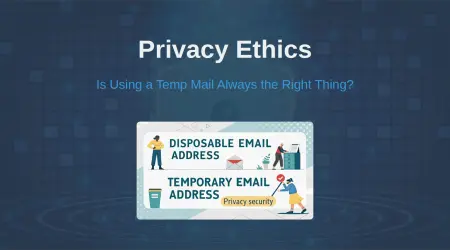
Is it ethical to use a temp email?
Using a disposable inbox to protect your privacy from commercial data collection is entirely ethical. Companies routinely collect and monetize email data without meaningful user consent. Choosing not to participate in that system is a reasonable personal decision.
Comparison: Temp Email vs. Real Email — Legal Risk Profile
| Scenario | Real Email | Temp Email |
|---|---|---|
| Sign up for free resource | Low risk | No risk |
| Join a one-time webinar | Medium spam risk | No spam risk |
| Free SaaS trial | High follow-up risk | No follow-up risk |
| Platform with strict ToS | Compliant | May violate ToS |
| Committing fraud | Illegal | Still illegal |
| Data breach exposure | High | None |
The pattern is clear: temp email reduces your risk profile in almost every scenario. The only exception is platforms that explicitly prohibit disposable addresses — and even there, the consequence is an account ban, not legal liability.
The Bottom Line
Using a temporary email is legal. It's protected by privacy principles in major legal frameworks around the world. It reduces spam, protects your identity, and gives you genuine control over your digital footprint.
The only things to watch for are platform-specific Terms of Service restrictions — and even those carry no legal consequences, just account suspensions.
If you've been hesitant to use a disposable inbox because you weren't sure where you stood legally, now you know. You're completely in the clear.
Want to see exactly how temp emails work in practice? Check out: Temp Emails: What They Are and How to Use Them Safely
References
- GDPR.eu — What is GDPR? https://gdpr.eu/what-is-gdpr/
- California Attorney General — CCPA Overview https://oag.ca.gov/privacy/ccpa
- European Data Protection Board — Data Minimization Principle https://edpb.europa.eu
- UK ICO — Guide to the UK GDPR https://ico.org.uk/for-organisations/guide-to-data-protection/
- Federal Trade Commission — Privacy & Data Security https://www.ftc.gov/business-guidance/privacy-security
- PDPA Thailand — Personal Data Protection Act https://www.pdpc.or.th
- South Africa POPIA — Protection of Personal Information Act https://popia.co.za
- Brazil LGPD — Lei Geral de Proteção de Dados https://www.gov.br/cidadania/pt-br
- NIST — Digital Identity Guidelines https://pages.nist.gov/800-63-3/
- ENISA — Privacy and Data Protection https://www.enisa.europa.eu/topics/privacy
Published: June 2026 | Author: Arslan | Category: Email Privacy & Legal