Anatomy of Deepfake Spear-Phishing
Anatomy of Deepfake Spear-Phishing
Deepfake spear-phishing represents a cutting-edge multi-stage cyber fraud. Unlike generic spam, these attacks are highly targeted: they begin with an email and culminate in a convincing fake video or voice call of someone the victim trusts (e.g. a company executive). By combining AI-driven personalization with advanced media synthesis, attackers can build an almost forensic-level deception chain. Experts define deepfake phishing as “when attackers use AI to create highly realistic fake voices and videos of trusted individuals”adaptivesecurity.com. In practice, every step – from initial contact to final exploitation – is automated and tailored. For example, attackers use Large Language Models (LLMs) to craft perfect, context-aware phishing emails (eliminating grammar errors and mirroring a person’s writing styletempmailmaster.io), and then follow up with AI-cloned phone calls and video calls. The result is a coordinated attack across email, voice, and video that is far harder to spot than older scams.
Key aspects of this evolution include:
- Hyper-personalized Emails: Attackers scrape public data (social media, company news, even travel schedules) so that each email looks like it’s written “just for you”tempmailmaster.iotempmailmaster.io. The language is flawless, invoking authority (“CEO requests urgent payment”) and urgency (“24-hour deadline”) to bypass rational scrutinytempmailmaster.iotempmailmaster.io.
- Multi-Channel Approach: After the initial email, the attack spills into other channels. A tailored voice call (vishing) and live video meeting (deepfake video) are often employed to reinforce the deceptiontempmailmaster.ioadaptivesecurity.com. For example, an attacker might first send a convincing “invoice” email, then call the target with a cloned CEO voice, and finally schedule a video conference where an AI-generated face issues the same request.
- Psychological Triggers: AI-generated content is laced with social-engineering cues (authority, urgency, personal context) to short-circuit decision-makingtempmailmaster.iohoxhunt.com. Workers are conditioned to trust their boss’s voice or face, so a deepfake that looks and sounds real can bypass usual safeguards. In one known case, finance staff wired $25 million after a deepfake video call showed their CFO insisting on the transfersinfosecinstitute.com.
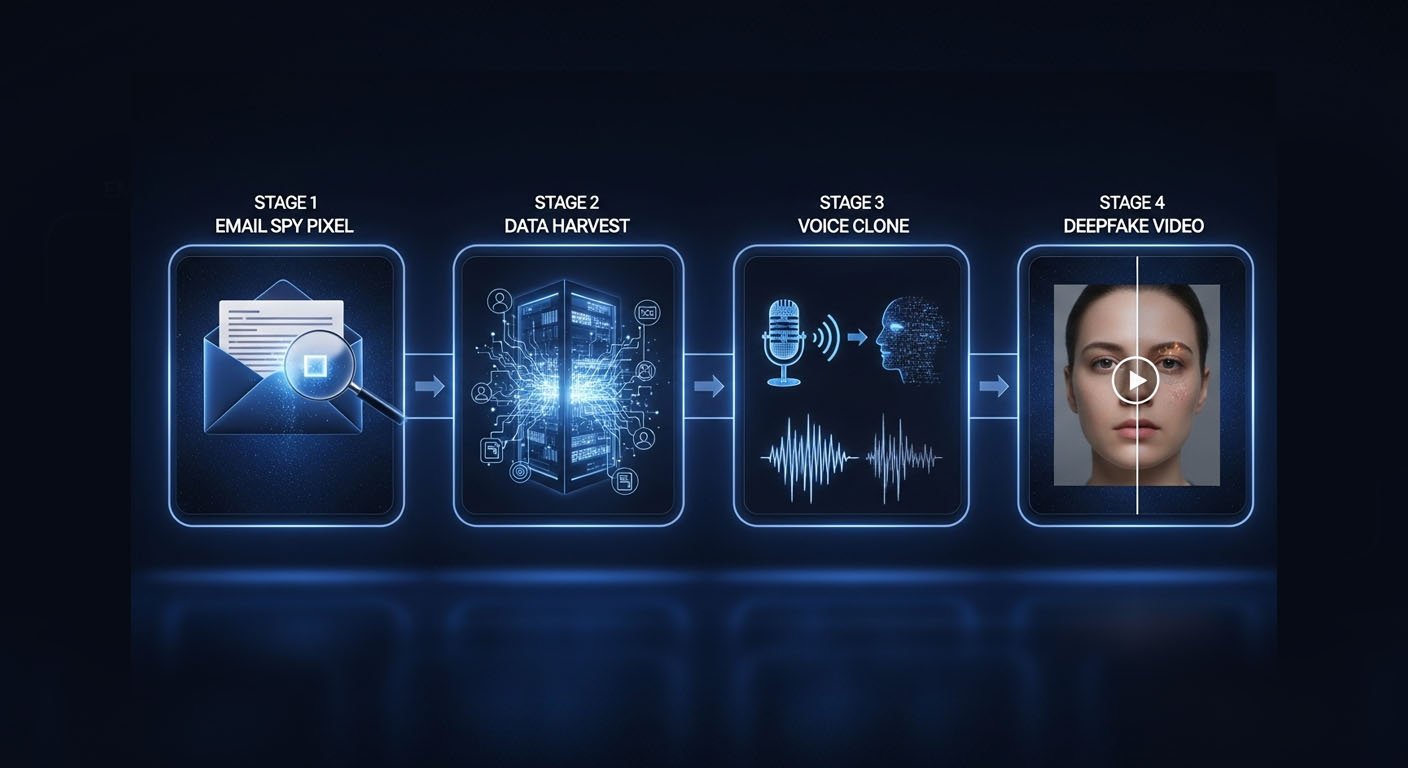
The sections below break down each stage of a deepfake spear-phishing attack in forensic detail – from the hidden tracking pixel in the first email to the final synthetic video. We'll also cover how defenders can detect and disrupt each stage, citing expert guidance and authoritative resources.
Stage 1: Email Reconnaissance (Spy Pixels and Tracking)
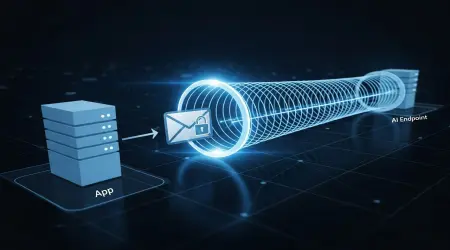
The attack chain typically begins innocuously: an email lands in the target’s inbox. This email may look like routine business – for example, an internal memo, a vendor invoice, or an urgent request from a colleague. Critically, it contains a hidden tracking pixel or similar beacon. A spy pixel is a tiny, often 1×1, transparent image linked to the attacker’s server. When the email is opened, the user’s email client automatically fetches this image, unknowingly reporting back data to the attackeren.wikipedia.org.
Figure 1: A spear-phishing email may contain hidden trackers (here symbolized by the tiny envelope icon inside a jar) that report when and where the message is opened.
- Hidden Tracking: By embedding a remote image URL in HTML email, attackers get a “read receipt” without the user’s consenten.wikipedia.org. The fetch includes the user’s IP address, device type, and timestamp. Researchers note that this reveals if and when an email was read, plus location info from the IPen.wikipedia.org. In one forensic analysis, an attacker identified a corporate board member’s office hours by tracking email opens, then intercepted sensitive information when the victim forwarded a confidential emailen.wikipedia.org.
- Reconnaissance Data: This “email-spy” data is valuable. The attacker confirms that the address is active (so future messages won’t bounce) and learns details like geographic location and network (e.g. home vs office)en.wikipedia.org. This can signal the victim’s routine – perhaps which time zone they’re in – allowing the attacker to time follow-up messages when the victim is working. By combining tracker data with scraped profile info (LinkedIn, company press releases, social media), AI tools assemble a complete target profiletempmailmaster.iotempmailmaster.io. For instance, an attacker might learn an executive is in London and then mention a London project or mention flying there next week, to build credibility.
- Email Confirmation: Sometimes the email itself asks for a confirmation (e.g. “please review the attached invoice”). If the victim interacts (opens a PDF, clicks a link), the attacker learns which tactics work. As one blog notes, isolating or sandboxing that first “pre-attack” email is crucial – if defenders break the reconnaissance phase, the rest of the attack collapsestempmailmaster.io. The adversary needs that initial signal (the “pre-attack signal”) to fuel everything else.
In short, the very first email acts as a digital footprint probe. It gathers intelligence quietly, then feeds AI systems to craft the next move. Cybercriminals now automate this step with advanced tools; as one analysis points out, LLMs combined with automated OSINT allow attackers to achieve “high-quality personalization” at scaletempmailmaster.iotempmailmaster.io. By the time most victims even read the email, the attacker already knows what time they read it and where – a severe breach of operational security.
Stage 2: Data Harvest and Credential Theft
Once the attacker confirms the email was opened, the next step is to harvest actual data. The initial email often lures the victim to click a link or open an attachment. This could be a seemingly routine request, such as a PDF invoice, an internal memo that requires feedback, or a link to “approve” a transaction. Because the email text is so well-crafted (thanks to AI), victims often proceed without suspicion.
- Hyper-Targeted Lures: The email content will include personal or company details collected during reconnaissance. For example, it might address the victim by name and cite a recent meeting, a project code, or a colleague’s name – all gleaned from web data. According to TempMailMaster research, attackers feed scraped details into an AI prompt so the email “feels legitimate and expected”tempmailmaster.iotempmailmaster.io. A finance team might receive an email about a “pending order” with the exact vendor name they just approved. Attackers have even achieved click-through rates above 50% in tests by referencing real vendor relationshipsbrside.com.
- Fake Login Pages: Often, the link goes to a spoofed website designed to collect credentials. For instance, it may mimic the company’s VPN login, an intranet portal, or a cloud service. When the victim enters their username and password, the attacker captures these credentials. Note that the attacker might know exactly which systems the victim uses (from LinkedIn or a profile) and clone them precisely. This is why AI phishing evades traditional filters – it defeats signature-based detection with unique, zero-day lurestempmailmaster.io.
- Social Engineering Attachments: Alternatively, the email might have a malicious attachment. Opening it could deploy a lightweight malware or monitoring tool. This second-stage malware might record keystrokes, capture screenshots, or even quietly steal voice recordings later. Any piece of data that can aid the next stages is on the table.
Because the reconnaissance phase was so detailed, this second stage succeeds more often. The attacker already knows which names, roles, and deadlines will trigger a response. They might ask for a “secure confirmation code” (in reality an MFA token) or urge immediate action on a wire transfer. If the link is clicked, the email tracker might even fire again (e.g. a new pixel on the “thank you” page), confirming the victim’s compliance.
In practice, many organizations disrupt this stage by using sandboxing or disposable addresses. As one internal study notes, using email sandbox environments can isolate and analyze suspicious content before it reaches the usertempmailmaster.io. By capturing the email in a safe space, defenders can neutralize the data signals (links, attachments, trackers) that would fuel the AI attack chain. Without those signals, the attacker’s AI models lack the context for a believable voice or video pretext.
Internal Reference: For more on the importance of email reconnaissance in AI-driven phishing, see Zero-Second Phishing: Stop AI Attacks tempmailmaster.iotempmailmaster.io.
Stage 3: Voice Cloning and AI Vishing
With credentials or useful context in hand, attackers often escalate to a voice-based social engineering step (often called vishing). They may place a phone call or send a voice message impersonating a known executive or partner. Thanks to modern AI, that voice may be a cloned deepfake of a real person.
- Gathering Voice Samples: Attackers obtain a target’s voice sample in many ways. Sometimes the reconnaissance phase yields them – perhaps the victim is a public speaker on podcasts or Zoom. Other times, the attacker calls the victim on a minor pretext (e.g. scheduling, survey) and records it. Even a few seconds of recorded speech are enough: state-of-the-art voice cloning tools can replicate accent and tone from 3–10 seconds of audiobrside.comtempmailmaster.io.
- Deepfake Audio Calls: The attacker then uses AI to generate a fake voice call. For example, the CFO’s AI-generated voice might call a finance clerk and say “We just spoke over email. Please transfer $100k to the account on the screen. Ask any questions by 3 PM – time is sensitive.” This matches the earlier phishing email’s context (e.g. “invoice” or “account detail” shared). The result is uncanny: security tests show AI-cloned voices capture subtle inflections and convincingly mimic public figuresbrside.comic3.gov. In one real incident, UK staff lost $243,000 after responding to an AI-cloned CEO’s voice during a callbrside.com.
- Layering Trust: By following up an email with a voice call, attackers reinforce trust. TempMailMaster reports that using a deepfake call “mimics normal communication patterns across multiple vectors, successfully building layers of trust”tempmailmaster.io. Many employees will think, “Oh, the CFO emailed me and now he’s calling – it must be real.” Attackers typically inject urgency: for instance, saying the wire must be sent immediately for a time-sensitive deal. Human bias kicks in, making even trained staff momentarily suspend skepticism.
- AI-Driven Vishing Surge: This is not theoretical. Recent data shows a 442% year-over-year surge in voice phishing incidents in 2024tempmailmaster.io. Criminals are leveraging generative AI like never before. Even organizations aware of the threat often struggle to keep up. As one resource notes, “vishing, which may incorporate AI-generated voices, is the malicious targeting of individuals using voice messages”ic3.gov. The FBI cautions that attackers are “exploiting AI-generated audio to impersonate well-known, public figures or personal relations” to increase the believability of their schemesic3.gov.
Defenders can spot clues in this stage: voice deepfakes often have subtle artifacts (like slight audio distortions or timing lags)ic3.gov. Agencies recommend pausing to verify unusual calls: for example, ask the caller a question only the real person would know or hang up and call back via a known company numberic3.govic3.gov. However, as high-quality deepfakes become common, even careful listeners can be fooled. The consensus is clear: never rely on a spontaneous voice request for high-value actions without independent verificationhoxhunt.comtempmailmaster.io.
Internal Reference: See AI Vishing Email Sandboxing for strategies to isolate these email calls before they turn into calls tempmailmaster.io.
Stage 4: Deepfake Video Deception
The final stage is the delivery of a deepfake video call or message. Here, attackers use AI to generate a video that visually impersonates a trusted individual – typically a senior executive or a familiar colleague. Victims are invited (often with urgency) to join a remote meeting or to watch a video. What they see and hear is completely fabricated, yet highly convincing.
- Real-Time Video Meetings: A common scenario is a fraudulent video conference. The victim receives a meeting invite (maybe branded with the company logo) for an urgent call about a transaction. When the call connects, the victim sees the face of their boss or vendor in real time. However, that image is a 3D deepfake: an AI model has animated it to lip-sync with an audio track (often the cloned voice). The background might show the office or a virtual meeting room. In many cases, all participants in the meeting are fake personas; one infamous scam had every face on screen generatedinfosecinstitute.com.
- High-Stakes Impersonation: Attackers exploit the human trust in visual cues. As one report warns, “attackers exploit this by utilizing deepfakes in spear-phishing and social engineering attacks, cloning the voices of executives or family members to manipulate victims”tempmailmaster.io. A finance employee might see and hear what appears to be their actual CFO instructing an urgent wire transfer to a new account. Convinced by the realism, the employee complies, only to later discover all images and voices were synthetic. The FBI’s review of incidents confirms that deepfake video calls are now part of Business Email Compromise (BEC) schemes – a CFO lost $1.2 million to such an attack in 2024tempmailmaster.io.
- Subtle Red Flags: Detecting a deepfake in the moment is very hard. Some cues include unnaturally still backgrounds, static limbs, or mismatched hand gestureshoxhunt.com. However, sophisticated AI can generate full-body movement. Experts say humans detect only about 24–30% of high-quality video deepfakes correctlytempmailmaster.io. Additionally, deepfake calls often push the victim to break protocol: for example, overriding a pending payment approval or bypassing a normal sign-off process. These context clues can be more reliable than the visual quality.
- Case Study: Infosec Institute recounts a prominent example: a Hong Kong company lost $25 million when a finance employee approved repeated transfers after a deepfake Zoom callinfosecinstitute.com. The employee recognized the (fake) CFO and colleagues on screen and felt the meeting was legitimate. Only after the money was gone did the fraud surface. This underscores how even vigilant teams can be victimized once multiple senses (sight, sound, context) are targeted simultaneously.
In effect, the email that seemed safe turned the victim into an unwitting actor in a staged drama. Each stage built on the last: the initial email provided the story, the voice added proof, and the video provided the final convincing evidence. By the time the victim realized, the fraud was complete. Security experts now classify such threats as “layered multimedia” attacks that require new detection strategiestempmailmaster.iohoxhunt.com.
Defense: Mitigating Multi-Stage Attacks
Defending against deepfake spear-phishing requires a multi-layered approach, just like the attack itself. Organizations must address each stage with both technology and training. Key defensive measures include:
- Email Hygiene and Sandboxing: Since the attack chain starts with email, filtering and analysis here is critical. Use advanced sandboxing to test links and attachments in a controlled environment before users see themtempmailmaster.io. Employ email authentication (SPF, DKIM, DMARC) to detect domain spoofing. Critically, treat any email with an unsolicited request as potentially malicious – even if it mentions familiar names or projectshoxhunt.com. Where possible, strip or block suspicious embedded content (disable automatic image loading to prevent pixel tracking).
- Disposable Addresses: Minimizing digital footprints can starve attackers of fodder. Industry guides recommend using temporary, disposable email addresses for low-trust sign-upstempmailmaster.io. By keeping the primary work address off marketing lists and forums, you reduce the data AI scrapers can gather. (See also TempMailMaster’s advice on shielding your real emailtempmailmaster.io.) This limits how much personal context an attacker’s AI can harvest.
- Multi-Factor and Transactional Controls: Strengthen authentication on critical systems with phishing-resistant methods (e.g. hardware tokens, FIDO2, biometric MFA) rather than SMS codes that can be phished. For financial transactions, implement out-of-band approvals: a wire request triggered in email should require a separate call or face-to-face sign-off outside any system controlled by the email content. The goal is that any high-value or urgent request must be verified by contacting the requester through a known, trusted channeltempmailmaster.iohoxhunt.com. Don’t call back numbers or links provided in the suspicious message; instead look up the executive’s number yourself.
- User Training and Vigilance: Regularly train staff to recognize these schemes. Emphasize that deepfake phishing can sound and look real, so the heuristic is to verify, not trust. Teach them red flags: any unexpected request that circumvents normal processes is suspect. As one expert advises, if a top executive appears in a video meeting, insist on additional proof (e.g. ask them to perform an action like showing a company ID or moving an object to prove liveness)infosecinstitute.com. Encourage a culture where questioning even senior personnel is acceptable when the situation feels off.
- AI-Based Detection: Invest in next-generation email security that uses machine learning to spot anomalies. Some tools now analyze the style and structure of language to detect AI-generated text patternstempmailmaster.io. Similarly, advanced network monitoring can flag unusual call patterns or video streams. For example, audio analysis can sometimes detect slight inconsistencies in cloned speechic3.gov. While no tool is foolproof, layering these defenses can raise the bar.
Figure 2: A conceptual shield against phishing and cyber threats. Comprehensive defenses involve both technical tools (firewalls, authentication, AI filters) and human protocols (verification procedures) working together.
Collaboration between technical and human measures is crucial. Agencies like CISA and the FBI now explicitly warn that non-digital, out-of-band verification (such as a direct phone call or office visit) is mandatory for any unusual requesttempmailmaster.ioic3.gov. As one public service announcement states, “Listen closely to the tone and word choice to distinguish a legitimate phone call from AI-generated voice cloning” and verify any requests independentlyic3.govhoxhunt.com. By treating unexpected calls or video conferences as potential red flags, organizations can catch an attack even after the AI screen-puppet is active.
In summary, each defense must align with the attack stage it aims to stop: block pixel tracking, catch malicious links, verify phone calls, and challenge video meetings. As TempMailMaster notes, this is a forensic-level challenge: defenders must “starve AI threat models of valuable data” by proactive measures like disposable emails and zero-trust policiestempmailmaster.io.
FAQs
What is a spy pixel in a phishing email? A spy pixel (or tracking pixel) is a tiny, invisible image in an email that, when loaded, tells the sender the email was openeden.wikipedia.org. In spear-phishing, attackers use pixels to confirm active addresses and learn the recipient’s IP/time zoneen.wikipedia.org. Essentially, it turns an ordinary message into a beacon, reporting details like the device and location without the user’s knowledge.
How do attackers use voice cloning in these scams? Attackers can clone someone’s voice from just a few seconds of audiobrside.comtempmailmaster.io. They then call the victim using an AI-generated voicemail or live conversation with that cloned voice. Because the voice sounds like a real colleague or boss, it convinces victims to comply (e.g. sending money). The FBI has observed criminals increasingly exploiting AI-generated voice to impersonate known contacts and add realism to scamsic3.gov.
Can deepfake video calls really fool people? Yes. High-quality deepfake videos can look and sound extremely realistic. In tests, human detection accuracy for advanced video deepfakes is very low (around 24.5%)tempmailmaster.io. In real incidents, employees have been defrauded by video calls they believed were real executivesinfosecinstitute.com. Because video adds emotional and contextual cues, it’s often more convincing than text or audio aloneinfosecinstitute.comadaptivesecurity.com.
What are some red flags for deepfake attacks? Look for unusual or unsolicited requests, especially around money or data. Verify any urgent request through known channels (e.g. call the sender’s office line). Watch for odd behaviors on video calls: static backgrounds, inconsistent lighting or shadows, or audio/video syncing issueshoxhunt.comic3.gov. Also, any request that violates standard policy (like skipping approval steps) should be treated as suspicioushoxhunt.com.
How can organizations stop such multi-stage attacks? Key steps include: isolating suspicious emails with sandboxingtempmailmaster.io; using phishing-resistant MFA; training employees to verify requests; and keeping workflows that force a human pause (e.g. “Call the CFO to confirm this transfer.”)tempmailmaster.iohoxhunt.com. Additionally, minimizing data exposure (for example by using disposable email addresses) can deprive attackers of the information they need to craft convincing messagestempmailmaster.io.
Conclusion
Deepfake spear-phishing attacks are meticulously choreographed frauds that exploit both technology and human trust. This forensic analysis has shown how an attack unfolds in stages: an initial email reconnaissance (often with spy pixels) builds the context, followed by data-harvesting through a personalized phishing lure, then an AI-driven voice call, and finally a live deepfake video exploit. Each phase is geared to reinforce the last, creating a chain of deception.
The lesson is clear: no single defense is enough. Organizations must treat every component of this chain as a potential vulnerability. By breaking the chain early (e.g. sand boxing emails) and verifying identity at every step, defenders can disrupt these sophisticated scams. As industry guides emphasize, non-digital verification and zero-trust protocols are now mandatory for high-stakes requeststempmailmaster.iohoxhunt.com. In a world of increasing cyber deception, vigilance, advanced security, and a healthy dose of skepticism are the best protection.
Written by Arslan – a digital privacy advocate and tech writer/Author focused on helping users take control of their inbox and online security with simple, effective strategies.